Robot lawnmowers have become increasingly affordable. Five years ago, entry-level models cost close to £1,000, but competition and technological advancement have changed the market. Budget-conscious gardeners with small to medium lawns and manageable layouts can now find quality options under £500. If you can stretch further, see our robot mowers under £1,000 or the full robotic lawnmower rankings.
These mowers suit typical UK back gardens but won’t replace ride-on mowers for expansive country properties. Below we cover six models with their strengths, compromises, and ideal garden types — all checked for current UK availability at the time of writing.
Comparison Table
|
Model |
Best For |
Lawn Size |
Price Range |
Rating |
|
Yard Force Compact 280R |
Small gardens |
Up to 280m² |
See box below |
4.3/5 |
|
WORX Landroid M500+ WR165E |
Smart features |
Up to 500m² |
See box below |
4.2/5 |
|
Gardena SILENO minimo 250 |
Quiet operation |
Up to 250m² |
See box below |
4.4/5 |
|
Einhell FREELEXO 500 BT |
App control |
Up to 500m² |
See box below |
4.1/5 |
|
Yard Force X50i |
Narrow passages |
Up to 500m² |
Check retailer |
4.2/5 |
|
Robomow RK2000 |
Larger lawns |
Up to 2,000m² |
See box below |
4.0/5 |
Amazon prices move constantly, so rather than print a figure that’s out of date by the time you read this, check the live price on each product box below.
Product 1: Yard Force Compact 280R
Best For: Small rectangular lawns up to 280m²
The Compact 280R remains the default choice for UK gardeners dipping a toe into robot mowing, and it’s still comfortably in stock through Yard Force’s own UK site and independent retailers. This model prioritises simplicity and reliability. The 16cm cutting width means slower coverage on larger spaces but performs adequately on typical terraced gardens.
Key Specifications: – Lawn area: up to 280m² – Cutting width: 16cm – Cutting height: 20-60mm – Slope capacity: 30% – Battery: 20V lithium-ion – Noise level: around 60dB
Strengths: – Excellent value proposition – Intuitive controls requiring no app – Operates quietly enough for residential areas – Manages slopes to 30% – Includes rain sensor and anti-theft PIN
Limitations: – Lacks app or smart connectivity – Narrow cutting width results in slower coverage – Struggles navigating narrow passages – Boundary wire setup requires afternoon commitment

Product 2: WORX Landroid M500+ WR165E
Best For: Gardeners seeking app control without premium pricing
WORX has moved its M500-class mower on since we last reviewed this category: the WR141E has been succeeded by the WR165E, sold as the Landroid M500+. It keeps the same pitch — smartphone integration for remote scheduling, cutting height adjustment and system notifications — on a wider 18cm deck than most budget competitors, with a floating cutting head that adapts to uneven terrain.
Key Specifications: – Lawn area: up to 500m² – Cutting width: 18cm – Cutting height: 30-60mm – Slope capacity: 20% – Battery: 20V lithium-ion – Noise level: low 60s dB
Strengths: – Dedicated WORX app with scheduling and AIA cutting-pattern technology – Wider 18cm cutting deck than most alternatives – Compatible with Alexa and Google Assistant – Supports optional accessory expansion – Established UK customer support infrastructure
Limitations: – App reliability has had reported hiccups after firmware updates – Higher noise output in its price category – Optional accessories increase total investment – Limited slope performance above 20%

Product 3: Gardena SILENO minimo 250
Best For: Quiet operation in smaller urban gardens
This model represents Gardena’s engineering reputation with premium-feeling construction. Operating at just 57dB — roughly the volume of a normal conversation — it suits gardens with nearby neighbours. The SensorControl system automatically adjusts cutting frequency based on growth rates.
Key Specifications: – Lawn area: up to 250m² – Cutting width: 16cm – Cutting height: 20-50mm – Slope capacity: 25% – Battery: 18V 2.1Ah – Noise level: 57dB
Strengths: – Exceptionally quiet operation at 57dB – Premium build quality exceeding budget competitors – Automatic cutting frequency adjustment – Compact design navigates tight spaces – Strong UK customer service
Limitations: – Limited to 250m² coverage – No companion app — Bluetooth remote control only – Narrow 16cm cutting width – Replacement blades positioned at higher price points

Product 4: Einhell FREELEXO 500 BT
Best For: Bluetooth connectivity on a budget
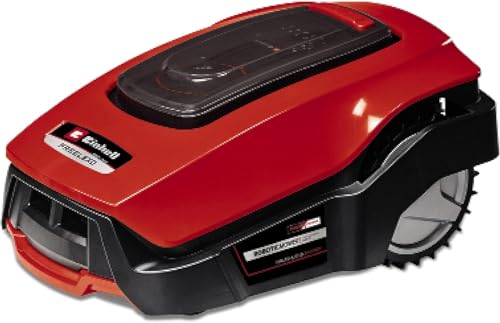
Einhell integrates smart features through direct Bluetooth pairing, eliminating any cloud account requirement. The mower handles slopes to 35% — exceeding most sub-£500 competitors — and features an 18cm deck. It’s still a current line for Einhell UK, sold direct and through UK retailers like Comet.
Key Specifications: – Lawn area: up to 500m² – Cutting width: 18cm – Cutting height: 20-60mm – Slope capacity: 35% – Battery: 18V Power X-Change, 2.5Ah – Noise level: around 62dB
Strengths: – Bluetooth app control without a subscription model – Superior slope handling at 35% – 500m² coverage at a competitive price point – IPX4 rain protection rating – Two-year standard warranty
Limitations: – Limited Bluetooth range requiring garden proximity – Dated app interface design – Tangling risk with extended garden hoses – Perimeter wire quality feels inferior to some alternatives
Product 5: Yard Force X50i
Best For: Gardens with narrow sections or awkward shapes
This model sits at the budget ceiling but offers features typically found in pricier alternatives. The iRadar ultrasonic obstacle detection reduces unnecessary contact with surroundings. The 22cm cutting deck is generous for this price tier, and Corridor Cut mode addresses narrow passages. It remains a genuinely current model — still sold through UK specialists and tracked on UK price comparison sites — though at the time of writing we couldn’t confirm a live Amazon UK listing for it, so there’s no box below for this one; check current UK stockists directly if this is the pick you want.
Key Specifications: – Lawn area: up to 500m² – Cutting width: 22cm – Cutting height: 20-60mm – Slope capacity: 40% – Battery: 28V lithium-ion – Noise level: around 65dB
Strengths: – iRadar sensors minimise obstacle collisions – Wider 22cm cutting deck – Specialised corridor mode for narrow sections – Full smartphone app with GPS tracking – Handles 500m² lawns
Limitations: – Positioned at the budget maximum – GPS tracking requires clear sky visibility – Heavier than compact rivals – Extended recharge times versus some alternatives
Product 6: Robomow RK2000
Best For: Larger lawns up to 2,000m² on a tight budget
This model stands apart by covering significantly larger areas than competitors. Rated for lawns approaching 1,500-2,000m², it addresses a gap in the sub-£500 market. The trade-off involves less refined cutting systems and more utilitarian engineering.
Key Specifications: – Lawn area: up to 2,000m² – Cutting width: 21cm – Cutting height: 15-45mm – Slope capacity: 36% – Battery: 26V 4.3Ah – Noise level: around 67dB
Strengths: – Unmatched coverage area at this price point – Wide cutting deck for the price – Handles slopes to 36% – Edge mode for boundary cutting – Suitable for larger rural properties
Limitations: – Louder operation than smaller rivals – Basic app experience – Less refined build quality – Heavier design complicates manual transport

Buying Guide Section
What to Prioritize When Shopping
Key considerations for budget purchases include:
- Area Rating: Select models rated higher than actual lawn size; manufacturer figures represent optimal conditions
- Cutting Width: Wider decks complete work faster but may struggle in confined spaces
- Slope Capacity: UK gardens rarely present flat terrain; minimum 25% capacity recommended for sloped areas
- Height Range: Lower minimums enable finishing control; higher maximums suit longer grass periods
- Weather Protection: IPX4 rating or better suits UK climate
- Boundary System: Nearly all sub-£500 models use perimeter wire; GPS-only systems remain premium offerings
- Theft Prevention: PIN protection or alarms matter for overlooked gardens
Perimeter Wire vs GPS Navigation
Almost every sub-£500 robot mower uses perimeter wire systems — thin cables pegged around lawn edges establishing boundaries. Installation requires one afternoon of work and remains reliable for years. GPS-only alternatives exist but exceed £1,000, making them unavailable in this price segment. Wire systems provide reliability; GPS glitches won’t cause escape incidents. Wire or not, robots miss the very edges, so a lawn edger is still worth having.
Realistic Lawn Coverage Expectations
Manufacturer area ratings deserve some scepticism. A 500m² mower technically handles that capacity but requires extended daily operation and simple lawn geometry. Gardens with numerous obstacles, narrow passages, or irregular corners see effective coverage drop 20-30%.
We’d recommend selecting a model rated at least 25% higher than your actual lawn size, providing headroom for spring growth spurts, reduced daylight operation, and intentional longer grass periods.
Installation and Maintenance
Initial setup involves placing the charging dock in a sheltered location with power access, pegging perimeter wire around the lawn edges, and letting the mower learn navigation patterns. Budget an afternoon for a typical garden.
Maintenance remains minimal: blade replacement every 2-3 months during growing season (£5-15 per set), monthly under-unit soft brushing, charging contact cleaning, and winter indoor storage. That’s the entirety of regular care.
Frequently Asked Questions Section
Are robot lawnmowers worth it for small gardens?
For lawns under 200m², robot mowers make sense if you dislike mowing or face mobility limitations. Seasonal time savings accumulate significantly. However, cordless push mowers may offer superior value for those who enjoy mowing or maintain tiny lawns.
Can robot lawnmowers cope with British weather?
Most models carry IPX4 or superior ratings, shrugging off rain though wet grass produces poorer cutting finishes. Rain sensors pause operation during heavy downpours. Shelter charging docks appropriately and bring mowers indoors over winter.
Do I need to mow before using a robot mower?
Yes — initial setup succeeds best on already-cut grass at normal length. Robot mowers trim incrementally rather than removing large quantities, so starting with overgrown grass produces poor results and extended adjustment periods.
Will a robot mower damage my lawn edges?
Most models leave 5-10cm unmowed strips along perimeters because wheels sit outside cutting decks. Occasional strimmer or edge-trimmer use maintains tidy final results.
Are there any ongoing costs?
Annual expenses average £15-30 for seasonal blade replacements, plus modest electricity costs (approximately £10-20 yearly for typical budget models). Batteries typically require replacement after 3-5 years.
Conclusion Section
For gardens under 500m², our top pick is the Gardena SILENO minimo 250, thanks to its build quality advantages and quiet operation — a real benefit for urban settings where noise matters. The WORX Landroid M500+ suits 500m² gardens where app integration is the priority, offering strong value against pricier smart mowers. The Robomow RK2000 addresses larger gardens, maximising coverage per pound spent.
Even a budget robot mower will still save you a dozen Saturdays a year — and that’s a decent return on under £500.