Introduction
Keeping your garden hedges neat and tidy can feel like a never-ending battle, especially if you’re wrestling with a heavy petrol-powered trimmer or frustrated by tangled extension cords. A cordless hedge trimmer offers the perfect middle ground—freedom of movement without the hassle of fuel or wires, combined with enough power to handle most garden tasks. Whether you’re maintaining a small suburban hedge or tackling thicker growth, finding the right model makes all the difference to both your comfort and your results.
In this guide, we’ve tested and compared the best cordless hedge trimmers currently available in the UK. We’ll walk you through the top picks across different budgets, help you understand what to look for when choosing, and answer your most common questions. By the end, you’ll have the knowledge to pick the perfect trimmer for your garden.
Quick Comparison Table
| Product | Best For | Price Range | Rating |
| Bosch AdvancedHedgeCut 36 | Mid-range all-rounder | £180–£220 | 4.5/5 |
| Makita DUH523Z | Premium performance | £250–£320 | 4.7/5 |
| Black+Decker CHT18 | Budget-conscious buyers | £70–£100 | 4.0/5 |
| Stihl HSA 56 | Thick branches & heavy use | £350–£420 | 4.8/5 |
| Ryobi OHT1855 | Lightweight, easy handling | £140–£180 | 4.3/5 |


Our Top Picks
Bosch AdvancedHedgeCut 36
Best for: Gardeners wanting reliable performance without breaking the bank
The Bosch AdvancedHedgeCut 36 is one of the most popular cordless hedge trimmers in UK gardens, and there’s good reason why. It delivers genuine cutting power in a lightweight package that most people can handle comfortably for a full afternoon’s work. The 36V battery system provides impressive runtime, and you’ll appreciate the dual-sided cutting action that speeds up the job.
This trimmer handles both soft new growth and tougher established branches well. The blade length is generous at around 55cm, meaning fewer passes over your hedges. Battery charging takes roughly an hour, and the 2.0Ah battery is reasonably priced if you want to buy a spare for uninterrupted work.
What we like: – Excellent value for money – Lightweight and well-balanced – Cuts cleanly with minimal vibration – Compatible with other Bosch 36V tools if you’re building a collection – Solid five-year warranty
Worth knowing: – Battery not included in some retailers’ bundles—check carefully before purchasing – Blade guard is a bit fiddly to clean out after very heavy cutting – Not the quietest option, though still significantly quieter than petrol models
Specifications: – Motor power: 36V lithium-ion – Cutting blade length: 55cm – Cutting capacity: up to 18mm diameter branches – Weight: 2.7kg (without battery) – Noise level: approximately 85dB – Battery type: 2.0Ah lithium-ion
Makita DUH523Z
Best for: Serious gardeners and professionals wanting premium quality
If you’re prepared to invest in a premium cordless hedge trimmer, the Makita DUH523Z is an exceptional choice. This is the trimmer you buy when you want one tool to last you 10+ years and handle almost any hedge challenge your garden throws at it. Makita’s reputation for durability and performance shines through here—every component feels robust and thoughtfully designed.
The dual-sided cutting action with anti-vibration technology makes extended use genuinely comfortable. The 60cm blade cuts a wide swathe, reducing the number of passes needed, whilst the variable speed control lets you adjust cutting power to match the task at hand. Batteries are sold separately, but Makita’s 18V system is widely available and reasonably priced.
What we like: – Outstanding build quality and reliability – Excellent cutting precision on both hard and soft growth – Variable speed control optimises battery life and performance – Comfortable grip with excellent balance – Anti-vibration technology reduces fatigue – Interchangeable with extensive Makita 18V tool ecosystem
Worth knowing: – Premium price reflects quality but will test your budget – Requires separate purchase of battery and charger – Slightly heavier than budget alternatives (around 3.2kg without battery) – May be overkill if you only have small hedges
Specifications: – Motor power: 18V lithium-ion dual battery system (requires two 3.0Ah batteries) – Cutting blade length: 60cm – Cutting capacity: up to 20mm diameter branches – Weight: 3.2kg (without batteries) – Noise level: approximately 83dB – Variable speed: yes (4,800–6,000 strokes per minute)
Black+Decker CHT18
Best for: Small garden hedges and occasional trimmers
The Black+Decker CHT18 is the entry point to cordless trimming, and it’s genuinely impressive value. Don’t be fooled by the budget price—this trimmer performs admirably for small to medium hedges and handles light maintenance work without complaint. It’s ideal if you’ve got just a few metres of hedging or prefer to trim little and often rather than let growth build up.
The compact size and lightweight design make it forgiving for users of any age or strength. Setup is straightforward, and the included battery charges in roughly 30 minutes, so you can get started quickly. The cutting width is modest at 45cm, but that actually makes it easier to control and manoeuvre around awkward corners and garden furniture.
What we like: – Genuinely affordable entry point to cordless trimming – Very lightweight and easy to handle – Battery and charger included – Compact enough to store almost anywhere – Quiet operation compared to petrol alternatives – Good for precision work in tight spaces
Worth knowing: – Battery life is limited—expect 20–30 minutes of continuous cutting – Not suitable for thick, woody branches – Cutting blade is shorter than premium models – Build feels less substantial than more expensive options – May need multiple charging cycles for larger gardens
Specifications: – Motor power: 18V lithium-ion – Cutting blade length: 45cm – Cutting capacity: up to 12mm diameter branches – Weight: 2.2kg (without battery) – Noise level: approximately 88dB – Battery included: 1.5Ah
Stihl HSA 56
Best for: Heavy-duty cutting and professional or semi-professional use
The Stihl HSA 56 sits at the premium end of the market and represents German engineering at its finest. This is the trimmer you choose when durability and performance in demanding conditions matter more than price. Stihl’s long heritage in outdoor power tools is evident in every detail—from the precision-engineered blades to the ergonomic handle design.
This model handles thick, woody branches that would struggle other trimmers. The cutting power is genuinely impressive, making short work of overgrown hedges or established shrubs. Despite the power, vibration levels are notably low, which matters if you’re doing extended work. The 56cm dual-action blades work smoothly and precisely, leaving a professional finish.
What we like: – Exceptional cutting power and sharpness – Robust, professional-grade construction – Excellent vibration damping for comfortable extended use – Outstanding warranty and Stihl service network across UK – Precise cutting action leaves neat hedge lines – Can handle demanding, overgrown situations
Worth knowing: – Significant investment—roughly £350–£420 depending on battery configuration – Premium Stihl batteries are expensive to purchase separately – Heavier than some alternatives (around 3.3kg without battery) – Professional-grade option, which may feel like overkill for small domestic gardens – Sharper blades require more careful handling
Specifications: – Motor power: 36V lithium-ion – Cutting blade length: 56cm – Cutting capacity: up to 24mm diameter branches – Weight: 3.3kg (without battery) – Noise level: approximately 82dB – Fuel option: None (fully electric)
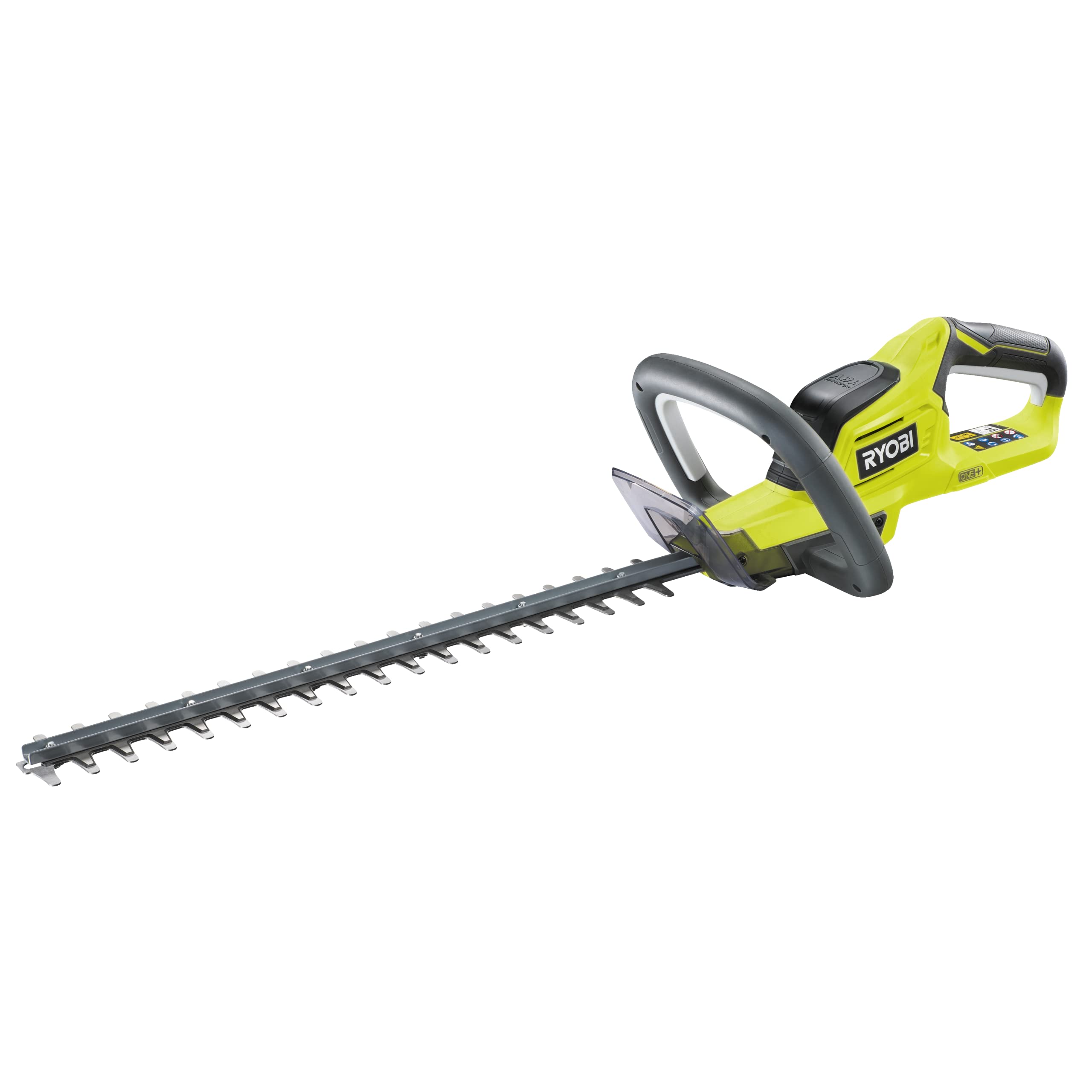
Ryobi OHT1855
Best for: Gardeners wanting lightweight, affordable, practical trimming
The Ryobi OHT1855 strikes a nice balance between the bargain-basement options and the premium models. It’s not quite as powerful as the Makita or Stihl, but it’s significantly more capable than the Black+Decker whilst remaining budget-friendly. Ryobi tools are increasingly popular in the UK, and this trimmer shows why—good engineering without the luxury price tag.
The lightweight design makes this trimmer genuinely pleasant to use for extended periods. The 52cm cutting blade is a decent width without being unwieldy. The one-handed operation and excellent balance mean you’re not fighting the tool, which counts for a lot when you’re standing on a ladder or reaching over your head. Battery life is reasonable for the price point, typically 30–45 minutes on a full charge.
What we like: – Excellent value for money – Very lightweight and easy to manoeuvre – Reasonable cutting performance for the price – Compatible with other Ryobi ONE+ tools if you’re building a collection – Easy one-handed operation – Low vibration levels for comfort
Worth knowing: – Battery and charger sometimes sold separately—verify what’s included – Not quite as powerful as mid-range alternatives – Cutting capacity is moderate—struggles with very thick branches – Less common in UK shops than Bosch or Makita, though availability is improving – Warranty is decent but not industry-leading
Specifications: – Motor power: 18V lithium-ion – Cutting blade length: 52cm – Cutting capacity: up to 16mm diameter branches – Weight: 2.6kg (without battery) – Noise level: approximately 84dB – Battery included: 1.5Ah (varies by bundle)
Buying Guide: How to Choose the Best Cordless Hedge Trimmer
What to Look For
Cutting Blade Length
Blade length determines how much area you cover with each pass. A longer blade (55–60cm) is more efficient for extensive hedges but requires more control. Shorter blades (45–50cm) are easier to handle and better for precision work or when you’re working near obstacles. Match the blade length to your typical hedge height and your physical strength—there’s no point having a 60cm blade if your arms tire after five minutes.
Battery Voltage and Runtime
Higher voltage batteries (36–40V) generally deliver more power and longer runtime, though they’re heavier and more expensive. Lower voltage options (18V) are lighter but may need recharging mid-job on larger gardens. Consider your garden size and how frequently you’ll trim. If you’re trimming once or twice yearly, modest runtime is fine; if you’re maintaining hedges weekly, longer runtime or a second battery is worthwhile.
Cutting Capacity
This measures the thickest branches your trimmer will handle. Budget models manage up to 12mm; mid-range reach 16–18mm; premium models handle 20–24mm. Thicker branches need more power and dull blades faster. Be honest about your hedge type—established hedges have thicker wood than young growth. If you’re unsure, opt for a model that handles at least 16mm comfortably.
Weight and Balance
You’ll be holding this tool above your head, often for extended periods. A 2.5–2.8kg trimmer feels noticeably lighter than a 3.2kg model when held aloft. Test weight in-hand if possible—two trimmers at identical weights can feel very different depending on handle design and balance point. Lighter isn’t always better (you might sacrifice power), but comfort matters for safety and the quality of your work.
Vibration and Noise Levels
Cordless trimmers are dramatically quieter than petrol, but noise still varies significantly. Lower numbers around 82–84dB are noticeably less fatiguing than models hitting 88dB. Vibration matters too—high vibration causes hand and arm fatigue on longer jobs. Better models include active vibration damping. Quiet operation is especially valuable if you’re trimming near neighbours.
Types of Cordless Hedge Trimmers
Single-Sided Blades
Less common than dual-sided models, these cut on one side only. They’re typically lighter and less expensive but require more passes over each hedge. Useful for precision work on shaped hedges where you don’t need speed.
Dual-Sided Blades
The standard design, with cutting action on both top and bottom. These are faster (roughly twice as quick as single-sided) and more efficient. Nearly all modern cordless trimmers use this design for good reason—the extra cutting surfaces dramatically improve productivity.
Variable Speed Models
Premium options let you adjust cutting speed to the task. Thick branches need full power; delicate new growth works fine at lower speeds. Variable speed also extends battery life by avoiding unnecessary high-speed running on easy tasks.
How Much Should You Spend?
Budget Option (£70–£120)
Entry-level models like the Black+Decker CHT18 suit occasional users with small hedges. Expect limited runtime, modest cutting power, and lighter construction. These are fine for light maintenance but won’t handle demanding situations.
Mid-Range (£150–£280)
This sweet spot offers genuine reliability and performance. The Bosch AdvancedHedgeCut 36 and Ryobi OHT1855 deliver good cutting power with reasonable runtime. Ideal for most UK domestic gardeners with established hedges and regular trimming routines.
Premium (£300+)
Professional-grade tools like the Makita DUH523Z and Stihl HSA 56 bring premium build quality, superior cutting power, and durability measured in decades. Worth the investment if you have extensive hedging, demanding cutting tasks, or plan to keep the tool for 10+ years.
Frequently Asked Questions
How long does a cordless hedge trimmer battery last?
Most modern lithium-ion batteries provide 20–45 minutes of continuous cutting, depending on battery capacity (measured in Ah—ampere-hours), voltage, and how hard you’re working. A 2.0Ah battery typically delivers longer runtime than a 1.5Ah battery in the same tool. Blade condition matters too—dull blades force the motor to work harder and drain batteries faster. Heavy cutting of thick branches reduces runtime compared to light maintenance trimming.
Can I use my hedge trimmer in the rain?
Most modern cordless trimmers are splash-resistant but not fully waterproof. Light rain is generally fine, but avoid heavy downpours or soaking the tool. Never submerge the motor or battery. Wet conditions also make the job messier—wet grass and leaves stick to blades, reducing efficiency. Trim in dry conditions when possible for the best results and safest operation.
What’s the best time of year to trim hedges?
Deciduous hedges are typically trimmed once in late summer (July–August) after the growth spurt, then lightly trimmed again in spring if needed. Evergreens often manage with just one trim in late summer. Formal hedges may need 2–3 cuts yearly for a neat appearance. Avoid trimming during nesting season (March–August) when birds are breeding. Hard frost can damage freshly cut growth, so avoid trimming in late autumn or early spring if your area is frosty.
How do I keep my hedge trimmer blades sharp?
Sharper blades cut cleaner and use less battery power. Have your blades professionally sharpened annually if you use the trimmer regularly—most garden centres and tool shops offer this service for £15–£30. Between professional services, you can maintain them by carefully sharpening with a fine file, though this requires care to maintain the correct angle. Never attempt to sharpen blades without removing the battery and taking full safety precautions.
Final Verdict
Choosing the right cordless hedge trimmer comes down to balancing your garden’s needs, your budget, and how often you’ll use it. For most UK gardeners, a mid-range model like the Bosch AdvancedHedgeCut 36 delivers excellent value—enough power for demanding work without unnecessary premium pricing. If your budget stretches further, the Makita DUH523Z and Stihl HSA 56 reward you with superior longevity and performance. Whatever you choose, a cordless trimmer beats the hassle of petrol and the inconvenience of cables every single time.