Autumn garden maintenance gets a lot easier with the right leaf-clearing kit. Instead of tedious hand-raking that wears out your arms, a good blower clears the lot in a fraction of the time. This guide covers options across budget tiers, from economical picks to serious high-power machines, with candid notes on strengths and limitations.
Quick Comparison Table
|
Product |
Best For |
Power |
Price |
|
Makita DUB186Z 18V |
Small gardens, budget-conscious |
18V cordless (body only) |
See card for current price |
|
Bosch UniversalGardenTidy 3000 |
Mid-sized gardens, blow/vac/shred |
3000W corded |
See card for current price |
|
Ryobi RY18BLCXA-0 18V |
Light, compact everyday tidying |
18V cordless (body only) |
See card for current price |
|
Makita DUB362 Twin 18V (36V) |
Large gardens, serious clearing |
Twin 18V cordless (kit) |
See card for current price |
|
Bosch AdvancedLeafBlower 36V-750 |
Serious work, high power |
36V cordless |
See card for current price |
Our Top Picks
Makita DUB186Z 18V Cordless Leaf Blower
Best for: Small to medium gardens on a budget
An accessible entry point for gardeners who want capable performance without much expense. At around 1.1 kg tool only, it is comfortable for longer jobs and easy to hold at arm’s length. It shares batteries with the wider Makita 18V LXT range, so it is a good first step if you plan to add other tools.
Performance overview: It copes well with light-to-moderate debris on hard surfaces and modest lawn areas. Dry leaves are no problem; heavy wet piles need more passes, which is normal for a lighter machine.
Key specs: – Motor: 18V LXT – Weight: approx. 1.1 kg (tool only) – Air velocity: up to 68 m/s – Speed control: variable trigger – Noise: approx. 82.5 dB(A) sound pressure – Battery and charger: sold separately
Pros: – Very light for prolonged use – Economical entry into cordless – Makita 18V battery compatibility across tool ranges – Quieter than petrol alternatives – Compact to store
Cons: – Battery and charger purchased separately – Less potent than larger models; thick leaf beds may need repeated passes – Runtime depends on the battery you choose
Best for: Small gardens and existing Makita 18V owners

Bosch UniversalGardenTidy 3000
Best for: Mid-sized gardens, general maintenance
A mains-powered 3-in-1 that blows, vacuums and shreds leaves, so it clears and tidies in one go. With constant power and no battery to charge, it suits gardens close to an outdoor socket.
Performance overview: The 3000W motor has variable speed, so you can turn it down near delicate plants or up for stubborn debris. The 50-litre collection bag makes it handy for bagging leaves rather than just moving them around.
Key specs: – Motor: 3000W electric, corded – Weight: approx. 4.7 kg – Functions: blow, vacuum, shred – Collection bag: 50 litres – Speed: variable
Pros: – Uninterrupted power with no battery to run down – Blow, vacuum and shred in one machine – Variable speed for different jobs – Strong value for the feature set – No battery replacement costs
Cons: – Cable limits your working radius – Needs an outdoor socket or a heavy-duty extension lead – Heavier than a cordless handheld blower – Cable management needed to avoid trip hazards
Best for: Mid-sized gardens near a power socket
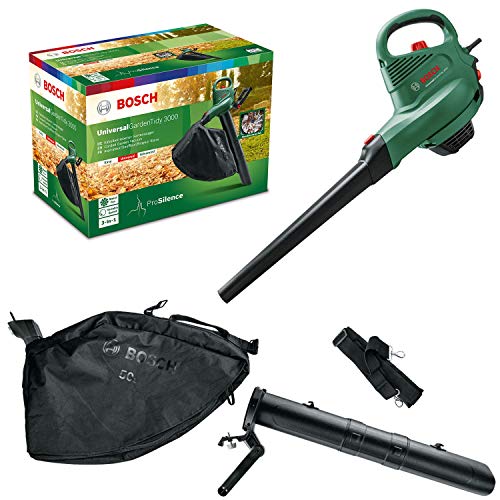

Ryobi RY18BLCXA-0 18V ONE+ Brushless Compact Blower
Best for: Lightweight, compact everyday tidying
A small, light brushless blower on the huge Ryobi ONE+ battery platform, a good option if you already own other ONE+ tools. It is well suited to quick tidy-ups of paths, patios and borders.
Performance overview: Air speed is impressive for the size at up to 241 km/h. Dual nozzles (round for hard surfaces, flat for softer areas) and an adjustable extension tube add versatility.
Key specs: – Motor: 18V ONE+ brushless – Weight: 1.1 kg – Air speed: 241 km/h – Air volume: 6.51 m³/min – Extras: variable speed trigger with lock-on, belt hook, twist-lock extension tube – Battery and charger: sold separately (roughly 14 minutes on a 5Ah battery)
Pros: – Very light and easy to handle – Fast air speed for its size – Works with ONE+ batteries – Two nozzles and adjustable tube – Belt hook for hands-free carrying
Cons: – Battery and charger sold separately – Modest runtime on smaller batteries – Less air volume than bigger 36V machines – Not the tool for large gardens or heavy wet leaf beds
Best for: Small to medium gardens and ONE+ owners

Makita DUB362 Twin 18V Cordless Leaf Blower
Best for: Large gardens, professional use, serious clearing jobs
For larger properties, this twin 18V machine runs two Makita 18V batteries together for a big jump in performance. Compacted leaves, damp debris and stubborn litter are dealt with far more easily. The card shows the kit that includes two 5.0Ah batteries.
Performance overview: A six-stage variable speed trigger lets you save battery on light work and use full power when needed. Because it uses standard 18V batteries, the batteries can also power other Makita tools.
Key specs: – Motor: brushless, twin 18V (36V system) – Weight: approx. 2.8 kg (tool only) – Air speed: up to 54 m/s – Speed control: 6-stage variable trigger – Noise: approx. 93.5 dB(A) (per retailer specification) – Extras: 3-stage telescopic nozzle, dual battery fuel gauge – Runtime varies widely with battery size
Pros: – Formidable performance on resistant materials – Uses two standard 18V batteries, shared with other tools – Six-stage speed control improves runtime – Telescopic nozzle for reach and control – Suited to big gardens and grounds work
Cons: – Needs two batteries, so a considerable outlay if you do not already own them – Heavier than single-battery models; long sessions tire the arms – More machine than a small garden needs – Louder than typical small cordless models
Best for: Large gardens and heavy-duty clearing

Bosch AdvancedLeafBlower 36V-750
Best for: High-power demanding work, dense leaf clearing
The Bosch 36V-750 is the premium cordless pick, a legitimate rival to the Makita twin 18V. Its brushless motor gives serious power with no fuel, no fumes and much lower noise than petrol.
Performance overview: A single 36V battery keeps things simpler than a paired setup. The variable speed dial lets you balance power against runtime, and it handles stubborn leaves across large areas. It is part of Bosch’s 36V Power for All system, so batteries are shared with other Bosch 36V garden tools.
Key specs: – Motor: 36V brushless – Weight: approx. 2.9 kg (tool only) – Air speed: 100 to 200 km/h – Air volume: up to 780 m³/h – Battery: 36V Power for All (2.0Ah minimum recommended) – Speed control: variable dial
Pros: – Strong power for its size – Single 36V battery is simpler than dual systems – Variable speed dial for control and runtime – Brushless motor and good build quality – Compatible with Bosch 36V garden tools
Cons: – Battery investment required for larger capacities – Fewer compatible accessories than the Makita range – Nearly 3 kg tool only, so heavier with battery fitted – The card may show a kit with a small 2.0Ah battery; consider a larger one
Best for: Bosch 36V owners and heavy leaf clearing

Buying Guide: How to Choose the Best Leaf Blower
What to Look For
Weight and balance matter because you hold a blower at shoulder height for long periods. Comfort at five minutes can turn into aching arms after twenty. Under 2.5 kg is ideal for handhelds; also consider balance, as some heavier machines feel lighter to hold.
Air speed and volume determine clearing ability. Air speed (measured in km/h or mph) creates the initial force, whilst air volume (m³/min) determines sustained clearing power. Higher values shift wet and heavy debris more easily, though noise rises too. Most UK gardens are well served by around 100-120 km/h or more.
Battery runtime needs real thought. A 20-minute claim is less appealing when a 30-minute recharge follows. Gardens under 200 m² need 20-30 minutes, moderate gardens 30-45 minutes, and larger properties over 500 m² benefit from spare batteries or a petrol machine.
Noise levels affect both your comfort and your neighbours. Battery and electric blowers are typically quieter than petrol machines, which regularly top 95 dB.
Types of Leaf Blowers
Cordless battery-powered blowers now dominate UK sales. They are clean, quieter, low maintenance and right for most gardens. Battery cost is the main trade-off, and batteries eventually need replacing. Makita, Bosch, Ryobi and DeWalt all make capable systems with good tool compatibility.
Corded electric blowers give constant power with no battery worry, ideal when you have an outdoor socket nearby. The cable limits your reach but removes battery costs. Best for small-to-medium gardens within 25-30 metres of a socket.
Petrol machines offer unmatched capability and freedom, suited to large estates or professional grounds work. They are noisy, need regular servicing and fuel handling, and are unpleasant for casual users.
Handheld versus backpack: most home users choose handheld. Backpack blowers spread the load and suit long professional use, but are overkill for seasonal tidying.
How Much Should You Spend?
Budget: Simple corded electric or a single 18V cordless body. Fine for small gardens and occasional use. Batteries typically need replacing after 2-3 seasons of regular use.
Mid-range: Better 18V or 36V cordless systems or top corded models. This balances capability, reliability and cost, and is the best fit for most UK households.
Premium: Higher-voltage cordless systems or industrial petrol units. Justified for large grounds, commercial use, or building a full battery-tool collection with one brand.
Consider how often you will really use it. A cheaper blower used weekly beats an expensive one gathering dust, so check the card for each blower’s current price.
Frequently Asked Questions
Q: Is a cordless leaf blower powerful enough?
Modern 36V cordless systems match or exceed many small petrol blowers for typical garden work, which is plenty for UK residential gardens. The main limit is runtime on big plots, which spare batteries or a higher-voltage system can address.
Q: Can I use a leaf blower on wet leaves?
You can, but wet leaves are heavier and harder to shift. Most cordless blowers struggle with heavy wet piles; you will get better results with a more powerful model or by waiting for leaves to dry.
Q: How often should I use my leaf blower?
Through autumn (typically September to November), use it regularly to deal with build-up. Weekly use during peak leaf fall handles manageable amounts rather than overwhelming piles.
Q: Are leaf blowers bad for the environment?
Battery-powered blowers have no exhaust emissions and are far quieter than petrol machines. Battery manufacture has an environmental cost, but for typical home use, cordless electric is the greener choice.
Final Verdict
The best blower depends on garden size, budget and how much upkeep you want. Most UK homeowners will find that a 36V-class cordless model from Makita or Bosch gives an excellent balance of power, runtime and value. Budget-minded buyers get real value from the Makita DUB186Z or the compact Ryobi RY18BLCXA-0, while the Bosch UniversalGardenTidy 3000 suits anyone near a power socket who wants to vacuum and shred too. Do not buy more machine than you need: a modest blower used often beats an expensive one left in the shed.