As the nights draw in and that familiar autumn chill settles over the garden, plenty of us start thinking about a patio heater to squeeze a few more evenings of outdoor living out of the year. Whether it is Sunday lunch that runs on a bit longer, a fire pit gathering with friends, or just wanting to sit outside with a cuppa without your hands going numb, a good patio heater can genuinely extend your garden season by weeks, sometimes months. The trouble is choosing between the two main types on the market: gas and electric. They work in very different ways, cost different amounts to run, and suit different gardens. In this guide we put gas and electric patio heaters head to head, look at some real examples currently sold in the UK, and help you decide which one is the better fit for your own patch of garden.
Quick verdict
If you have a large patio or entertaining space and want serious warmth that does not depend on a power socket, a gas patio heater is generally the better choice, so long as you are happy storing and swapping gas bottles. If your outdoor space is smaller, close to the house, or you would rather flick a switch than wrestle with a cylinder, an electric infrared or wall-mounted heater is usually the more practical and family-friendly option. For most modest UK gardens and patios, we would lean towards electric, but it genuinely depends on your layout, budget and how often you use it, so it is worth reading the full comparison below before deciding.
Gas patio heaters: how they work, pros and cons
Gas patio heaters run on bottled propane or butane, typically stored in a cylinder that sits inside the base of the unit. A burner at the top heats the surrounding air, and the classic ‘pyramid’ or ‘mushroom’ shape you will have seen outside pubs and beer gardens up and down the country is designed to radiate that heat downwards and outwards across a fairly wide area.
On the plus side, gas heaters tend to produce a lot of heat, often somewhere in the region of 10 to 13kW for a typical freestanding model, which makes them a good match for larger patios or gardens where you want warmth to reach several seats around a table. Because they do not need a power lead, they are also properly portable: you can wheel one to wherever the party has ended up, or use one at the far end of the garden with no outdoor socket in sight.
The downsides are worth being honest about too. You need somewhere safe and ventilated to store spare gas bottles, and running costs depend on the price of propane refills, which can add up if you use the heater regularly through fixture-heavy garden entertaining. Gas heaters also involve a naked flame and a hot casing, so they need to be used upright, on level ground, away from anything flammable, and never indoors or in an enclosed space such as a gazebo with the sides zipped shut. Strong wind can also cause the flame to flicker or reduce efficiency, even on heavier, weighted bases.
A widely available example is the Outsunny 11kW freestanding gas patio heater, a classic wheeled pedestal design with a large anchorable base, pulse ignition and tip-over protection, sold through Amazon UK for around £140 to £160. For something built with commercial and heavy domestic use in mind, the Dellonda DG2 is a 13kW freestanding gas patio heater with a fully enclosed propane cylinder chamber and adjustable heat control, typically priced around £140 to £160 on Amazon UK. Both are propane-fuelled, both need a gas bottle bought separately in most cases, and both are aimed squarely at larger outdoor spaces rather than a small balcony.
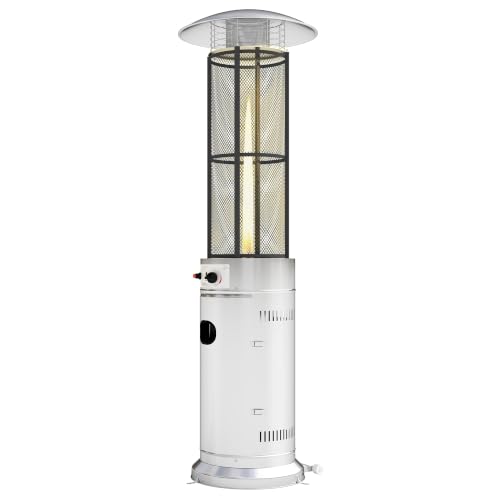
- 37000 BTU, 11 KW: Propane heater provides plenty of strong heat. Covers areas up to 1.5 m. Heat is adjustable - control the temperature easily
- 45° tip-over protection: Outdoor heater automatically shut offs if it falls over, preventing any serious accidents
- Metal structure, with large anchorable base: A tough portable heater stand which is suitable for outdoor use. Large base to stand steady, with three pre-drilled holes to secure into ground with stakes (not included)
- Two 5.8 cm wheels: Easy to move this outdoor gas heater around. Safe and smooth movement - take it to the spot you require
- Dimensions: 180H x 53.5L x 53.5W cm. Gas consumption: 854 g/hr. Tank room: 71.3H x ⌀38 cm; Assembly required. 1x AAA battery and regulator are required, not included
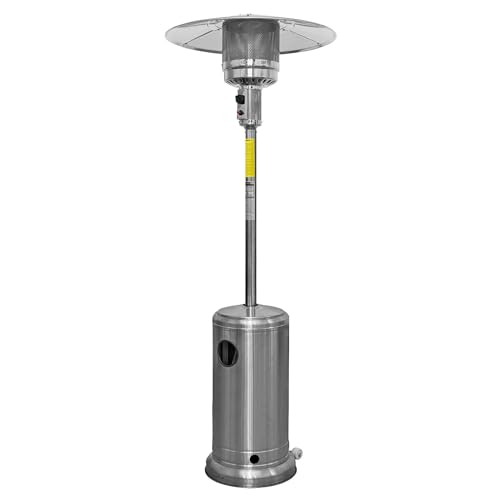
- TRADITIONAL FREESTANDING STYLE - The burner head is positioned approximately 2.19m off the ground and the metal reflector directs radiation downwards and outwards.
- ADJUSTABLE HEAT - Variable temperature output controls and a fully enclosed propane gas cylinder chamber with safety tip over switch. Emits up to 46,000 BTU of heat.
- STURDY CONSTRUCTION - Made with strong, rugged materials for constant sustained use to ensure this will last a long time.
- VERSATILE - Excellent heat output for outdoors, suitable for cafes, restaurants, terraces, wedding receptions or just simply your garden.
- DIMENSIONS - (W x H): 81 x 219cm. Maximum Gas Bottle Size (W x H): Ø32.5 x 70cm.
Electric patio heaters: how they work, pros and cons
Electric patio heaters plug into the mains and use an infrared, halogen or ceramic element to produce radiant heat. Rather than warming the air the way a gas heater does, radiant heat warms people and objects directly, a bit like standing in a patch of sunshine. This is why you will often feel the benefit almost immediately once you are within range, even though the wider air temperature around you has not changed much.
The main appeal of electric is convenience. There is no fuel to buy, store or run out of halfway through a barbecue, and most models switch on and off instantly with a remote or a simple dial. Many electric heaters are also quieter, lighter, and some are designed to be wall or ceiling mounted, which is handy if floor space on your patio or under a pergola is limited. Because there is no open flame, they are often seen as a gentler option around children and pets, although the heating element itself still gets hot to the touch, so supervision is still sensible.
The trade-off is that electric heaters generally have a lower output than gas, often in the 1.5 to 2.5kW range for domestic models, which means they tend to suit a more focused seating area rather than heating an entire patio evenly. You will also need a nearby power source, ideally a properly installed outdoor weatherproof socket rather than a household extension lead trailed out through a window, which is not something we would recommend for safety reasons. Running costs are tied to your electricity tariff rather than gas bottle prices, so it is worth checking a heater’s wattage against your own tariff if you plan to use it often.
A good example of a freestanding electric option is the Senelux 2000W infrared patio heater with tripod, which has an IP65 weather resistance rating, remote control, and a price typically around £140 to £150 on Amazon UK. For smaller spaces, the Sahara 2000W wall-mounted electric patio heater is a compact, fixed option that mounts to a wall or fence panel (it can also be ceiling-mounted or used free-standing) and is usually available for around £75 to £90, making it one of the more budget-friendly ways to add a bit of warmth to a small patio or balcony.
No products found.
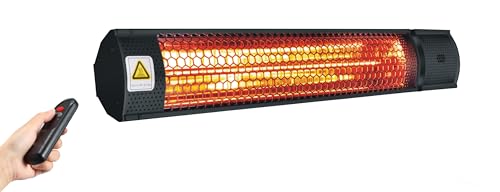
- WARM IN ABOUT A SECOND: The 2000W gold halogen lamp starts heating almost as soon as you switch it on, so there's no waiting around on a chilly evening. This outdoor wall heater covers an area of 12–18m²
- CHOOSE YOUR COMFORT LEVEL: The included remote control has two power settings, 1000W and 2000W, letting you turn the heat up or down from your seat. Use the higher setting on colder nights and the lower one when you just want to take the edge off
- MOUNT IT WHERE IT SUITS YOU: Fix this electric patio heater to a wall or ceiling to keep it out of the way. Prefer to move warmth around the garden? Add the Sahara Tripod Heater Stand (sold separately)
- BUILT FOR LIFE OUTSIDE: Sahara designs its patio heaters for outdoor use, and an IP65 rating means this one is dust-tight and protected against water jets from any direction. Damp, breezy evenings are no problem for this garden heater
- PLENTY OF EVENINGS AHEAD: The gold halogen lamp is rated for 6,000 hours of use, and the slim black housing looks neat on brick, render or timber
Gas vs electric patio heaters: feature comparison
| Feature | Gas | Electric |
| Running cost | Depends on propane/butane refill prices; a high-output heater used often can add up over a season | Depends on your electricity tariff; lower wattage generally means lower running cost per hour |
| Heat output / warmth | Typically 10-13kW, good for warming a wider patio or several seats | Typically 1.5-2.5kW, better suited to a focused seating area at closer range |
| Safety | Naked flame and hot casing; needs stable ground, ventilation for the gas bottle, and care around children | No open flame, though the element still gets hot; generally considered the more family-friendly option |
| Weather resistance | Handles wind reasonably well due to weighted bases, though flame can flicker in strong gusts | Look for an IP rating (such as IPX4 or IPX5) for outdoor use; still best sheltered from heavy rain |
| Portability | Wheeled, freestanding models can be moved anywhere in the garden with no power lead needed | Freestanding models are portable but tied to socket location; wall-mounted versions are fixed |
| Running noise | Virtually silent aside from a faint burner hiss | Virtually silent; some fan-assisted models have a faint hum |
| Upfront cost | Around £100-£220 for most freestanding domestic models | Around £40-£180 depending on wall-mounted or freestanding infrared design |
Who should buy which?
Small patio or balcony: an electric wall-mounted heater, such as the Sahara 2000W model, makes sense here. It takes up no floor space, needs no gas bottle storage, and is proportionate to a smaller area.
Large garden or entertaining space: a gas pedestal heater like the Outsunny 11kW model, or a heavier-duty model like the Dellonda DG2, will generally spread warmth further and suit a bigger group sitting around a table or fire pit area.
Close to an outdoor power socket: if you already have a weatherproof outdoor socket near your seating area, an electric heater is the simpler, lower-maintenance choice, with no fuel to arrange or store.
Off-grid areas of the garden: for an allotment, a far corner of a large garden, or anywhere without power nearby, gas is really the only practical option, since a freestanding gas heater needs nothing but a filled bottle.
Families with young children or pets: electric heaters are usually the more reassuring choice because there is no naked flame, though we would still recommend keeping any heater, gas or electric, out of reach, on stable ground, and never left unattended around little ones.
Final verdict
There is no single correct answer here, it really comes down to your garden, your budget and how you like to use your outdoor space. If you want maximum warmth across a larger patio and do not mind the faff of gas bottles, a heater like the Outsunny 11kW pedestal model or the Dellonda DG2 will do a proper job of keeping a crowd warm through a chilly autumn evening. If your space is smaller, you already have power nearby, or you simply want the convenience of switching a heater on and off without thinking about fuel, an electric option such as the Senelux infrared heater or the Sahara wall-mounted heater is likely to suit you better. Whichever you choose, check the weather resistance rating, look for a tip-over or overheat cut-off switch, and always follow the manufacturer’s safety instructions, particularly around gas bottle storage and never using a gas heater in an enclosed space. Get the right heater for your garden and you should be able to enjoy a few more comfortable evenings outside well into the UK autumn.