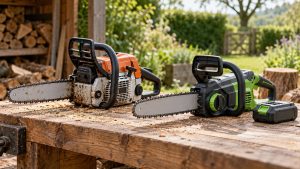
Chainsaws pose significant dangers to home gardeners, though they offer tremendous efficiency when handled properly. This guide addresses the needs of domestic users (garden enthusiasts, allotment holders, and weekend firewood processors) rather than professional arborists. Those undertaking paid chainsaw work or felling trees exceeding 380mm diameter require NPTC certification.
Before You Switch On: The Non-Negotiables
1. Proper PPE Every Time
Essential protective equipment includes:
- Chainsaw trousers or chaps rated Class 1 (Type A for ground work) featuring Kevlar fibres that halt chain movement
- Boots with steel toecaps and cut-resistant materials
- Head protection combining a forestry helmet with integral ear defenders and mesh visor, or separate components
- Chainsaw-rated gloves
- High-visibility clothing for work near roads or shared spaces
A complete kit costs approximately £200-£300 and represents a worthwhile investment for saw owners.
2. Know Your Saw
Users must understand their equipment’s manual, including the throttle trigger, trigger lockout, chain brake, chain catcher, bar nose, fuel and chain oil systems, chain tensioning, and manual brake engagement.
3. Never Work Alone for Serious Jobs
Someone within voice range should be present when cutting larger branches, capable of calling emergency services if needed.
4. Consider a One-Day Course
Lantra-accredited or NPTC-based introductory chainsaw courses cost around £150-£250 for a day and cover exactly the skills that stop new users cutting themselves.
Pre-Cut Checklist
Execute this verification before every use:
- PPE properly fastened
- Chain sharpness assessment (dull chains prove more hazardous)
- Chain tension validation (3-5mm lift at midpoint)
- Chain oil reservoir verification
- Fuel freshness or battery charge confirmation
- Chain brake functionality test
- Working area clearance confirmation
- Escape route planning
Understanding Kickback
Kickback is the single biggest cause of serious chainsaw injuries. It happens when the top quadrant of the bar nose touches wood while the chain is moving, or when the chain in the cut is pinched suddenly.
Prevention relies on three core principles:
- Avoid cutting with the upper section of the bar nose
- Refrain from plunge-cutting without specialised training
- Maintain a full thumb wrap around the front handle
Holding the Saw Correctly
Proper positioning requires:
- Left hand fully wrapping the front handle with thumb underneath
- Right hand gripping the rear handle with thumb near the trigger
- Slightly bent arms with relaxed shoulders
- Hips aligned toward the cut rather than shoulders
- Shoulder-width stance with slight forward weight distribution
- Never straddling the saw or cutting above shoulder height
Cutting Techniques for Common Garden Jobs
Cutting a Fallen Branch (Bucking)
Identify compression and tension sides. Create a shallow cut on the compression side (approximately one-third depth), then complete from the tension side to prevent pinching.
Limbing a Fallen Tree
Position yourself opposite the limb being cut, using the trunk as protection. Single strokes suit small limbs; larger supported limbs require underside cuts initially.
Cross-cutting Logs for Firewood
Use a log horse or cradle to secure logs. Never rest logs on feet or thighs. Cut downward with bumper spikes pressed into wood, using the bumper as pivot.
Felling a Small Tree (under 150mm diameter)
Execute a simple hinge cut:
- Plan the fall direction toward clear space
- Create a notch cut (1/4 to 1/3 trunk diameter)
- Make the opposite back cut, leaving a 25-50mm hinge
- Step back along your escape path once movement begins
Larger trees demand professional assistance.
Fuel, Oil and Servicing
Fuelling a Petrol Saw
- Refuel on bare ground away from ignition sources
- Cool the saw for a minimum of two minutes before opening the fuel cap
- Wipe the cap area before opening
- Use fresh two-stroke mix at the manufacturer’s ratio (typically 50:1)
- Move the saw at least 3 metres from the refuelling location before starting
Chain Oil
Biodegradable chain oil is environmentally superior. Cold UK winters call for thinner formulations. Engine oil is a poor substitute.
Sharpening
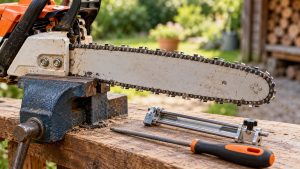
A sharp chain throws proper wood chips. A dull chain throws fine sawdust. Sharpen after approximately one hour of cutting or when chip size diminishes. Round file sharpening kits cost roughly £15.
Gear we’d use: Oregon 4.0mm (5/32″) Chainsaw File and Holder (Q16265C)
This is a simple file holder with angle guides, so you keep the correct filing angle by eye and hand rather than guessing. It suits 1/4″ and 3/8″ low-profile chains, common on smaller domestic saws. Check your chain’s pitch and file diameter in your manual before buying, as other chains need a different file size.
Key specs: 4.0mm (5/32″) round file with holder and angle guides; for 1/4″ and 3/8″ low-profile chains; manual, no power needed; see card for current price.


Storage and Transport
- Store in a dry shed with a bar scabbard fitted
- Remove batteries from cordless models, storing them indoors at 40-60% charge
- Empty petrol tanks on saws unused for more than 30 days
- Use scabbards and restraints during vehicle transport
- Remove batteries or empty the fuel for extended transport
UK Law and Common Sense
Domestic users on private land require no licence, though HSE guidance expects NPTC/Lantra qualifications for work or contractor situations. Hired tree surgeons should hold CS30 and CS31, plus CS38 or CS39 for climbing work, with £5 million public liability insurance standard.
Working Near Power Lines and Structures
Avoid cutting branches within 5 metres of live overhead lines. Contact your DNO for free isolation. Similarly, refrain from felling trees within one tree-length of structures; hire certified professionals instead.
When to Stop
Fatigue indicators warranting cessation include:
- Straight-armed, locked-shoulder gripping
- Forcing the chain rather than letting it cut naturally
- Hand tremors upon trigger release
- Growing frustration with slow progress
First Aid and Emergency Planning
Essential first aid kit components:
- Haemostatic dressing (Celox or QuikClot) for arterial bleeding
- Standard pressure dressings
- Foil blanket for shock
- Sterile eye-wash
- Mobile phone with signal confirmed
Note your exact location using what3words before commencing work.
When to Call a Professional
Professional arborists should handle:
- Trees exceeding 380mm trunk diameter
- Trees near buildings, boundaries, power lines, or roads
- Dead, diseased, or storm-damaged trees
- Cutting above shoulder height
- Any work involving climbing with a saw
Professional services typically cost £200-£600 and provide safer, more efficient solutions.
Final Word
A chainsaw is not a tool to be feared, but it is a tool to be respected. Dress for it, maintain it, use it with good technique, and walk away when you are tired.