An unventilated greenhouse can top 40°C on a hot UK day, which scorches seedlings and stresses established plants. Automatic vent openers solve the problem with no electricity: a sealed cylinder of temperature-sensitive wax expands as the air warms, pushes a piston and opens the vent, then contracts and lets a spring close it again as things cool down.
Below are the best automatic greenhouse vent openers for UK growers across every budget, with a comparison table and practical fitting advice.
How Automatic Vent Openers Work
Nearly all openers on the UK market work the same way: a temperature-sensitive wax (sometimes called paraffin or mineral wax) sealed inside a metal cylinder. As the air warms, the wax expands and drives a piston outward, levering the vent open through a linkage. As it cools, the wax contracts and springs pull the vent shut.
Most units start to open at around 12-16°C and are fully open by about 25°C. The specs that matter are lifting capacity (5-7kg is typical), maximum opening distance (around 30cm), and the number of springs, because more springs give better resistance to wind.
At a Glance: Top Automatic Greenhouse Vent Openers for 2026
|
Model |
Best for |
Lift load |
Springs |
Price |
|
Gardman Greenhouse Auto Vent |
Small, sheltered greenhouses |
Light vents |
Single |
See card for current price |
|
Vitavia Automatic Roof Vent Opener |
Vitavia greenhouse owners |
Standard vents |
Single/double |
See card for current price |
|
Palram Automatic Vent Opener |
Palram polycarbonate houses |
Light vents |
Single |
See card for current price |
|
Bayliss MK7 Triple Spring |
Best all-rounder |
~6kg |
Triple |
See card for current price |
|
Univent Automatic Opener |
Large or twin vents |
Heavy vents |
Double |
See card for current price |
|
Bayliss XL Autovent |
Exposed, windy sites and heavy vents |
~5.5kg (28cm reach) |
Double |
See card for current price |
|
Ellovent Special Heavy Duty |
Value heavy-duty pick |
Heavy vents |
Double |
See card for current price |
1. Budget Single-Spring Autovent — Best Cheap Option
The Gardman Greenhouse Auto Vent is the classic low-cost wax opener. It uses the same mechanism as the premium models for far less money, fits most standard roof vents with basic tools and suits small greenhouses in sheltered spots.
Key specs: wax-cylinder operation, no power needed, single-spring closing, fits standard roof vents.
Pros: – One of the most affordable ways to automate a vent – Fits standard roof vents with minimal tools – No electricity or batteries
Cons: – Single spring struggles to hold a vent shut in strong winds – Lighter construction and a shorter lifespan than premium brands – Less lifting power for heavy vents
Best for: Small, sheltered greenhouses and first-time buyers.

2. Vitavia Automatic Roof Vent Opener — Best for Vitavia Greenhouses
This manufacturer-specific opener is made to bolt onto Vitavia vent frames without much adjustment. It uses the familiar wax cylinder mechanism with an adjustable trigger temperature and is a sensible mid-range choice if you own a Vitavia greenhouse.
Key specs: wax cylinder, adjustable opening temperature, designed for Vitavia roof vents.
Pros: – Purpose-designed for Vitavia vent frames – Minimal adjustment needed when fitting – Dependable wax mechanism
Cons: – Best value only on Vitavia or compatible greenhouses – Lighter spring set offers less wind resistance than a triple-spring model
Best for: Vitavia greenhouse owners.
3. Palram Automatic Vent Opener — Best for Polycarbonate Greenhouses
Matched to Palram (Canopia) polycarbonate greenhouse and lean-to vents, this opener uses a simple single-spring wax mechanism and lines up correctly straight out of the box. It suits the lighter vents typical of polycarbonate structures.
Key specs: wax cylinder, single spring, designed for Palram/Canopia roof vents, no power needed.
Pros: – Made for Palram vent frames, so fitting is painless – Right for lighter polycarbonate vents – Compact, low-key appearance
Cons: – Limited lifting strength, not for heavy glass vents – Little advantage on non-Palram greenhouses
Best for: Palram and Canopia polycarbonate greenhouse owners.

4. Bayliss MK7 Triple Spring — Best All-Rounder
Made in the UK, the Bayliss MK7 fits timber or aluminium vents up to roughly 60cm x 60cm, lifts around 6kg and opens to about 30cm. Its standout feature is the triple-spring closing system, which shuts the vent firmly and resists wind far better than budget single-spring units. Opening can be adjusted from about 12°C, and Bayliss offers a two-year guarantee.
Key specs: triple spring, ~6kg lift, ~30cm opening, vents up to about 60cm x 60cm, adjustable from about 12°C.
Pros: – Triple-spring close resists gusty conditions – Universal fit for most standard roof vents – UK-made with a two-year guarantee – Long-established reputation for durability
Cons: – Costs more than generic budget openers – Universal fit needs slightly more adjustment than a branded match
Best for: Most UK greenhouses, the one to buy if you are unsure.
5. Univent Automatic Opener — Best for Large or Twin Vents
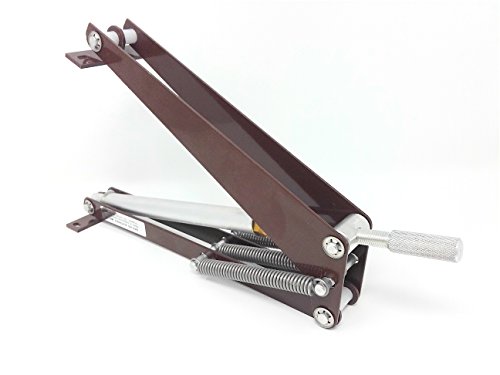
Favoured by dedicated growers and allotment holders with larger or heavier vents, the Univent uses a double-spring design with a temperature-sensitive hydraulic cylinder and an easy-clip system that speeds up installation. It has the extra capacity to manage roof lights beyond the reach of budget units.
Key specs: double spring, hydraulic wax cylinder, easy-clip fitting, medium-duty lift.
Pros: – Strong lift for large or heavy vents – Double spring for a secure close – Easy-clip system makes fitting quick
Cons: – Among the pricier options – More capacity than a small hobby greenhouse needs
Best for: Large or twin vents, allotment greenhouses.

6. Bayliss XL Autovent — Best for Exposed, Windy Sites
Designed for open, windy sites or unusually heavy roof vents, the Bayliss XL has anodised aluminium construction and recycled plastic brackets. It lifts about 5.5kg with a longer 28cm reach and has an adjustable trigger between roughly 12°C and 24°C. Bayliss includes a two-year guarantee.
Key specs: ~5.5kg lift, 28cm reach, adjustable ~12-24°C, anodised aluminium, two-year guarantee.
Pros: – Heavy-duty build for exposed locations – Long reach and powerful, regulated lift – Adjustable trigger temperature and two-year guarantee
Cons: – One of the most expensive options here – Overkill for sheltered suburban plots
Best for: Exposed, windy sites and heavy vents.

7. Ellovent Special Heavy Duty Opener — Best Value Heavy-Duty Pick
Sitting between budget cylinders and the premium Bayliss units, the Ellovent Special is a heavy-duty autovent from Elloughton Greenhouses built to lift heavier vents and hold them closed more firmly than a single-spring budget model. It is a real step up from generic openers without the price of the top-end Bayliss range.
Key specs: heavy-duty wax cylinder, designed for heavier vents, no power needed.
Pros: – Heavy-duty lift at a mid-range price – Suits standard and heavier glass vents – A substantial upgrade on generic budget units
Cons: – Less widely supported than the Bayliss range – Fitting brackets may need a little adjustment on some vents
Best for: Standard-to-heavy glass vents on a sensible budget.
How to Choose the Right Autovent
Start with your greenhouse rather than the opener. Match the weight and size of your vent to the opener’s lifting capacity, and leave some headroom: openers running at their maximum rating wear out faster. Small, sheltered hobby greenhouses suit a budget or mid-range single-spring unit. Exposed sites need double or triple-spring models that close firmly without chattering or being lifted by wind.
If you own a branded greenhouse, check whether the manufacturer makes a matching opener first, as these need the least fitting effort. Otherwise universal openers like the Bayliss MK7 or a double-spring model fit nearly any standard roof vent. Most gardeners benefit from more than one opener: a roof autovent paired with automatic louvre openers on the side keeps air moving through the whole structure.
Fitting and Setting Up Your Autovent
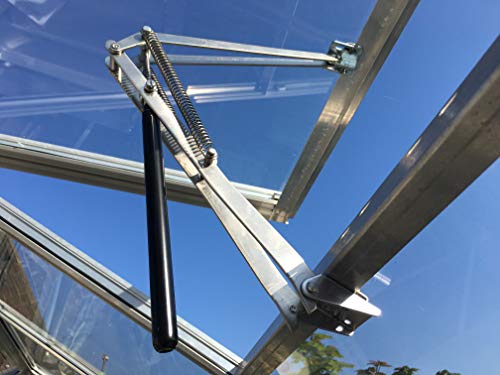
Fitting suits any competent DIYer and usually takes under thirty minutes. Most openers attach with brackets to both the vent frame and a fixed glazing bar, with the piston linkage connecting them. Fit with the vent closed, follow the supplied template for correct geometry, and check nothing blocks the vent’s full swing.
Temperature adjustment reveals itself in warm weather: screw the cylinder in to open at a lower temperature or out to delay opening. Allow several days to settle before fine-tuning. During extreme heat, prop vents open manually as well. In winter, remove the opener or set it to its maximum trigger to stop unwanted venting on cold snaps. A little light oil on the piston once a year keeps it moving smoothly.
Autovents Through the UK Gardening Year
Spring is when an autovent earns its keep. March and April in the UK bring wild temperature swings, with cold nights and surprisingly hot afternoons under glass, and tender seedlings need protecting from both. In summer the opener works almost continuously and, combined with shading and ventilation, prevents wilting in tomatoes and cucumbers.
Autumn reduces opener activity, which is the moment to combine it with greenhouse insulation and heating to hold overnight warmth. In winter the opener often stops working or is set to its maximum trigger, as a closed greenhouse keeps heat better and unexpected warm-afternoon venting can dissipate overnight warmth.
Frequently Asked Questions
Do automatic vent openers need electricity or batteries? No. They work passively, with a wax cylinder expanding and contracting with temperature. Nothing to plug in, charge or replace.
At what temperature do they open? Most begin opening at around 12-16°C and reach full opening by about 25°C. Nearly all can be adjusted by turning the cylinder.
How many openers do I need? At least one for the roof vent. Larger greenhouses benefit from an opener on each roof vent plus automatic side louvres positioned low, drawing cool air in while hot air escapes upward.
Will one hold up in strong wind? Single-spring budget units may rattle or lift on exposed sites. Windy locations need double or triple-spring models like the Bayliss MK7 or XL for a firmer close.
Should I remove it in winter? Many gardeners disconnect it or set the highest trigger temperature, keeping the vent closed and preserving warmth through the cold months.
Final Thoughts
An automatic vent opener is one of the smartest small upgrades you can make to a greenhouse. For typical UK gardeners, the Bayliss MK7 Triple Spring is the one to buy: it is well built, fits almost anything, closes firmly in the wind and is backed by a two-year guarantee. Owners of exposed greenhouses or heavy vents should consider the Bayliss XL or Univent, while sheltered hobby gardeners may find a budget single-spring opener like the Gardman perfectly adequate.
Fit yours before the first significant heat of the year so seedlings get the best start.