A greenhouse can swing from over 30°C on a sunny morning to close to freezing overnight, often within the same day. A decent thermometer with max/min memory is one of the cheapest and most useful tools you can own, because it tells you what happened while you were not looking. This guide reviews options across every budget, from battery-free capillary models to smart WiFi sensors that text your phone when the heater fails.
Quick Verdict Summary
For basic needs: the Brannan Digital Max Min Greenhouse Thermometer is reliable and affordable. For humidity monitoring: the ThermoPro (TempPro) TP55 adds a hygrometer. For remote checking: the TempPro TP65C wireless sensor set or the Govee WiFi thermometer hygrometer. For unpowered greenhouses: a mercury-free capillary max/min thermometer such as the SupaGarden, at a low price.
How to Choose a Greenhouse Thermometer
Max/min Memory is the Feature That Matters
Any thermometer tells you the temperature right now, but a greenhouse thermometer worth buying records the maximum and minimum since it was last reset. That lets you see overnight lows and daytime peaks when you were not there.
Analogue or Digital?
Capillary thermometers need no batteries and are durable, but they are harder to read precisely. Digital models are easier to read and more precise, but depend on batteries that can struggle in cold, damp conditions.
Do You Want Humidity Too?
Humidity control helps prevent botrytis, mould and damping off. Combined thermo-hygrometers show both figures, so you can decide when to ventilate or damp down the floor.
Wired, Wireless or Smart?
Basic models stay in the greenhouse and you read them on the spot. Wireless sets pair an outdoor sensor with an indoor display. Smart WiFi models send data to a phone app and can alert you to low temperatures.
Placement and Accuracy
Mount the thermometer in shade at plant height, away from direct sun and away from the heater, or it will read the sunshine rather than the air your plants feel.
The Best Greenhouse Thermometers for 2026
1. Brannan Digital Max Min Greenhouse Thermometer – Best Overall
A trusted British brand and the simplest way to get reliable max/min readings in a greenhouse.
Key specs: Digital display showing current, maximum and minimum temperature; Celsius/Fahrenheit switch; wall-mounted or freestanding; battery powered. See card for current price.
Pros: – Reliable max/min memory with a simple one-button reset – Copes well with greenhouse humidity – Trusted British brand at a fair price
Cons: – No humidity reading – Basic display, no backlight for dark winter mornings
Best for: Most UK gardeners who want straightforward temperature monitoring.

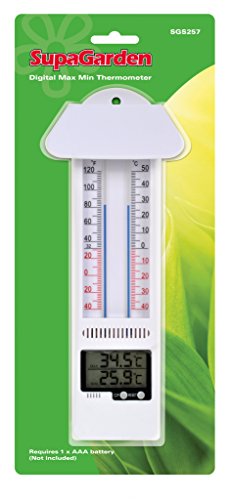
2. SupaGarden Min/Max Thermometer (Mercury Free) – Best Budget and No Batteries
A traditional liquid-column max/min thermometer with no power source to fail.
Key specs: Mercury-free liquid-column design with min/max index markers; reset by magnet; no batteries. See card for current price.
Pros: – Battery-free operation – Very affordable – Durable and long-lasting
Cons: – Needs careful reading – No humidity, backlight or alerts
Best for: Unheated greenhouses, allotment plots without power and anyone wary of batteries.
3. TempPro TP49 Mini Thermo-Hygrometer – Best Compact Option
A tiny, inexpensive temperature and humidity display that fits where larger units will not.
Key specs: Digital display of temperature and humidity; comfort icon indicator; compact body. See card for current price.
Pros: – Very inexpensive – Space-saving for propagators and cold frames – Includes humidity monitoring
Cons: – No true max/min memory – Small display for close viewing
Best for: Propagation benches, cold frames and small greenhouses with limited staging space.


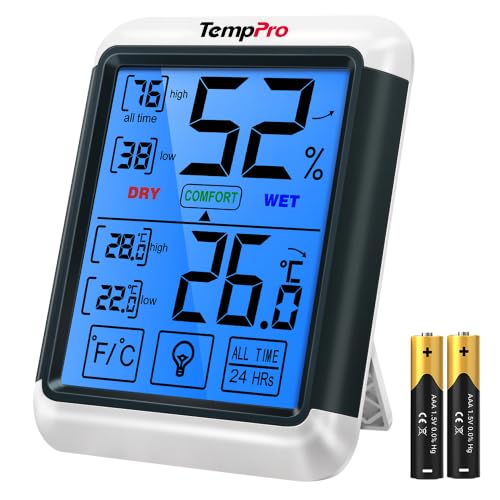
4. ThermoPro TP55 Temperature and Humidity Monitor – Best for Humidity
A large, backlit thermo-hygrometer with proper record-keeping.
Key specs: Large backlit touchscreen; temperature and humidity; 24-hour or all-time max/min records; comfort indicator. See card for current price.
Pros: – Large backlit display readable across the greenhouse – Temperature and humidity with useful memory – Competitively priced
Cons: – Somewhat bulky for very small greenhouses – Table-style design suits sheltered placement better than damp frames
Best for: Gardeners raising seedlings who want to prevent damping off and mould.
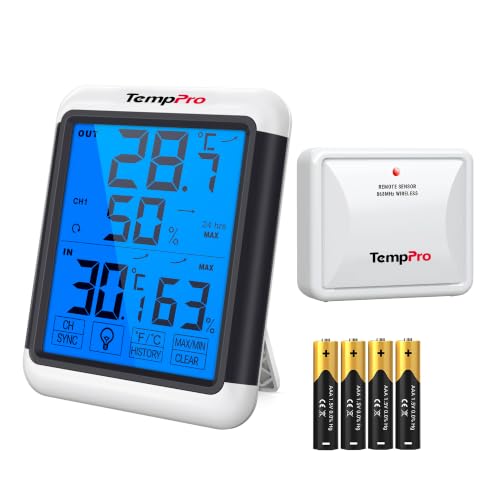
5. TempPro TP65C Wireless Hygrometer Thermometer – Best Wireless
An indoor display with a remote outdoor sensor, so you can check the greenhouse without going out in the cold.
Key specs: Indoor display plus remote sensor; temperature and humidity; max/min records; backlit touchscreen; up to 150m open-air range. See card for current price.
Pros: – Check the greenhouse from indoors – Temperature and humidity for both locations – Max/min records
Cons: – More expensive than standalone units – Two sets of batteries to look after
Best for: Greenhouses located far from the house.
6. Govee WiFi Room Thermometer Hygrometer – Best Smart Choice
A WiFi sensor that logs data to an app and alerts your phone when the temperature drops.
Key specs: WiFi sensor with app alerts; temperature and humidity logging; 2-year data storage and export; around 50m WiFi range. See card for current price.
Pros: – App logging with accessible history – Early warning of heater failure and cold snaps – Compact, easy to place
Cons: – Needs WiFi that reaches the greenhouse – Priciest option reviewed
Best for: Gardeners overwintering valuable or tender plants.

Greenhouse Thermometer Comparison Table
|
Thermometer |
Type |
Humidity |
Max/min |
Price |
|
Brannan Digital Max Min |
Digital |
No |
Yes |
See card for current price |
|
SupaGarden Min/Max (Mercury Free) |
Analogue |
No |
Yes |
See card for current price |
|
TempPro TP49 |
Digital compact |
Yes |
No |
See card for current price |
|
ThermoPro TP55 |
Digital |
Yes |
Yes |
See card for current price |
|
TempPro TP65C |
Wireless |
Yes |
Yes |
See card for current price |
|
Govee WiFi Room Thermometer Hygrometer |
Smart WiFi |
Yes |
App log |
See card for current price |
Getting the Best from Your Greenhouse Thermometer
Fix it at plant height, in the shade, and keep it out of direct sun so it reads the air temperature your plants actually experience rather than the glare of the glass. Build an evening reset routine so you capture each night’s low. In summer, watch daytime maximums and humidity, and open vents or damp down the floor before plants become stressed.
Frequently Asked Questions
What Temperature Should a Greenhouse Be?
To overwinter tender plants, keep minimums above 3-5°C for frost protection. Heated propagation benches work best around 18-21°C. In summer, aim to keep daytime maximums below 30°C with ventilation and shading to avoid crop stress.
Where Should I Put a Greenhouse Thermometer?
At plant height, in the shade, away from direct sun, the heater and the door. A north-facing upright or a spot under the staging usually gives the truest air-temperature reading.
Do I Really Need a Max/Min Thermometer?
A plain thermometer only tells you the temperature at the moment you look, which is almost never the moment that matters. Max/min readings capture the overnight low and midday peak that should guide your heating, ventilation and frost-protection decisions.
Our Verdict
The Brannan Digital Max Min Greenhouse Thermometer offers the best balance for most gardeners. Add the ThermoPro TP55 if you want humidity monitoring, choose the TempPro TP65C wireless set for a greenhouse far from the house, or the Govee WiFi sensor if you are protecting valuable overwintering plants. For an unpowered plot, the SupaGarden mercury-free capillary thermometer does the job with no batteries. Good temperature monitoring takes the guesswork out of greenhouse management.