A good compost bin is the quiet workhorse of any sustainable garden. It turns kitchen scraps, lawn clippings and soft prunings into rich, crumbly compost that costs nothing and beats most of what you can buy by the bag. But there are dozens to choose from, from budget plastic converters to insulated hot composters costing several times as much. Which one actually suits your garden?
We’ve picked seven compost bins you can buy on Amazon UK, covering every budget and style – from the no-fuss council-scheme classic to a year-round hot composter, tumblers, a wormery and a traditional wooden beehive bin.
Our Quick Picks
- Best overall: HOTBIN Hot Composter (200L) – fast, hot, year-round composting
- Best for small gardens: HOTBIN Mini (100L) – the same hot technology in a smaller bin
- Best budget: Blackwall 220L Compost Converter – the council-scheme classic
- Best tumbler: Outsunny 160L Dual Chamber Tumbling Composter
- Best compact tumbler: Miracle-Gro Dual Chamber Compost Tumbler (2 x 70L)
- Best wormery: Wormcity 4-Tray Wormery with worms included
- Best wooden: Forest Garden Pressure Treated Wooden Beehive Composter
Compost Bin Comparison at a Glance
|
Compost bin |
Type |
Capacity |
Best for |
|
HOTBIN |
Hot composter |
200L |
Year-round composting, food waste |
|
HOTBIN Mini |
Hot composter |
100L |
Small gardens, hot compost |
|
Blackwall Compost Converter |
Static bin |
220L |
Budget, beginners |
|
Outsunny Dual Chamber Tumbler |
Tumbler |
160L total |
Faster compost, no forking |
|
Miracle-Gro Dual Chamber Tumbler |
Tumbler |
2 x 70L |
Smaller gardens and patios |
|
Wormcity 4-Tray Wormery |
Wormery |
4 trays (100L size) |
Kitchen waste, courtyards |
|
Forest Garden Beehive Composter |
Wooden static bin |
See listing |
Traditional and cottage gardens |
Compare live prices and ratings:
Invalid table id.
How We Chose These Compost Bins
Capacity matters: we wanted bins that suit everything from a small courtyard to a family garden or allotment. Build quality matters too – compost bins live outside in British weather all year, so they need to shrug off sun, rain and frost. We also looked at how easy each bin is to fill, turn and empty, because a compost bin you can’t get into is one you won’t use.
Finally, we considered value. Many UK councils still subsidise the Blackwall converter, so it’s worth checking your council’s scheme. At the premium end, the HOTBIN range costs more upfront but keeps composting through winter, when traditional bins slow to a crawl.
The 7 Best Compost Bins UK 2026
1. HOTBIN Hot Composter (200L) – Best Overall
Type: Insulated hot composter | Capacity: 200L | Best for: Fast, year-round composting and cooked food waste
The HOTBIN is the bin we’d buy if we were starting from scratch. It’s an insulated 200-litre composter designed to run hot – HOTBIN quotes 40–60°C – which means it breaks waste down far faster than a standard bin and keeps working through a British winter. Unlike ordinary bins, it’s designed to take cooked food as well as veg peelings and garden waste.
The insulated shell holds heat well, and a hatch at the bottom lets you take out finished compost without disturbing the rest of the heap. For best results you need to feed it regularly and add a bulking agent (such as wood chips) to keep air moving through the heap.
Pros
- Hot composting all year round, even in winter
- Takes cooked food as well as garden waste
- Much faster than a standard cool bin
- Bottom hatch for easy emptying
Cons
- Costs much more than a basic bin
- Needs regular feeding to stay hot
- Ongoing cost of bulking agent
2. HOTBIN Mini (100L) – Best for Small Gardens
Type: Insulated hot composter | Capacity: 100L | Best for: Small gardens and smaller households
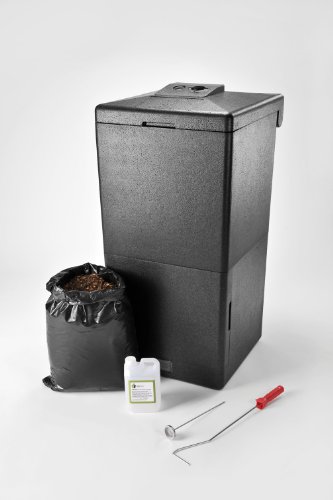
Love the idea of a HOTBIN but don’t have the space, or the waste, to fill 200 litres? The Mini works the same way at half the size. It uses the same insulated hot-composting design in a slimmer bin that tucks neatly against a fence or beside a shed.
It’s ideal for couples or small families with a modest garden. It still takes cooked food and still runs hot. The trade-off is volume: you’ll fill it more often, and you may want a separate pile for bulky prunings.
Pros
- Compact – fits where a standard bin won’t
- Same hot-composting benefits as the full-size HOTBIN
- Lower upfront cost than the 200L model
Cons
- Fills quickly in a busy household
- Still needs regular feeding to stay hot
- Not ideal for big lawns with lots of clippings

3. Blackwall 220L Compost Converter – Best Budget
Type: Static cool-composting bin | Capacity: 220L | Best for: Beginners, allotments and budget buyers
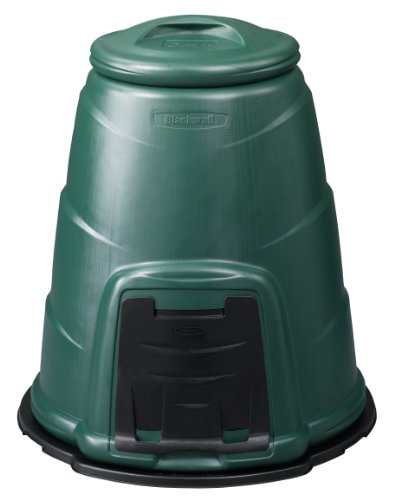
The Blackwall is the compost bin most British gardeners start with. It’s the classic cone-shaped converter with a lid on top and a hatch at the bottom for removing finished compost. Many UK councils sell it at a subsidised price through home-composting schemes, and even at full retail it’s great value for 220 litres.
Don’t expect hot composting – this is a cool, slow bin that typically takes 9–12 months to produce finished compost. But it’s tough, simple to set up and very forgiving for beginners. Stand it on bare soil so worms can get in, layer browns and greens, and let nature do the rest.
Pros
- Excellent value – often subsidised by councils
- Generous 220-litre capacity
- Simple, sturdy, no moving parts
Cons
- Slow compared with hot bins and tumblers
- Bottom hatch can be fiddly when compost is wet
- Not suitable for cooked food or meat
4. Outsunny 160L Dual Chamber Tumbling Composter – Best Tumbler
Type: Dual-chamber tumbler | Capacity: 160L total | Best for: Faster compost without forking
Tumblers speed up composting by letting you spin the bin instead of forking the heap over, which keeps everything mixed and aerated. This Outsunny model has two chambers on a solid steel frame, so you can keep filling one side while the other finishes. It rotates a full 360° and has sliding doors for loading and emptying.
It won’t run as hot as a HOTBIN, but a well-fed tumbler turned every few days can give you usable compost within a couple of months in summer.
Pros
- Two chambers – one filling, one finishing
- Easy to turn, no forking needed
- Raised off the ground, which helps deter rodents
Cons
- Limited volume for large gardens
- Slows down a lot in cold weather
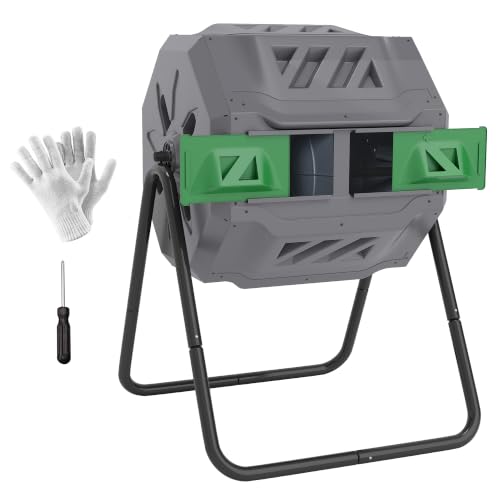

5. Miracle-Gro Dual Chamber Compost Tumbler – Best Compact Tumbler
Type: Dual-chamber tumbler | Capacity: 2 x 70L | Best for: Smaller gardens and patios
If you like the idea of tumbling but don’t need as much capacity as the Outsunny, the Miracle-Gro dual chamber tumbler is a neat, compact option. Two 70-litre chambers with sliding doors let you run one batch while filling the other, and turning the drum a few times every couple of days keeps the compost aerated and working.
It’s a good fit for smaller households that produce a steady stream of kitchen scraps and light garden waste.
Pros
- Compact footprint
- Two chambers for continuous composting
- Sliding doors for easy filling and emptying
Cons
- Smaller total capacity than the Outsunny
- Like all tumblers, slows down in winter

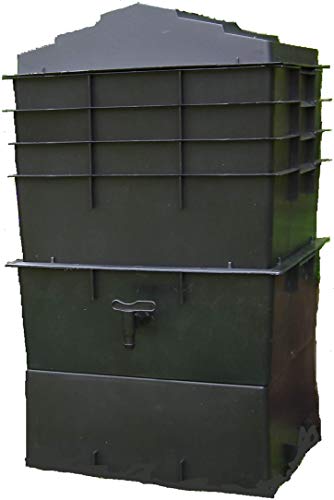
6. Wormcity 4-Tray Wormery – Best Wormery
Type: Stacking-tray wormery | Size: 4 trays (100 litre size) | In the box: 500g worms, coir bedding and worm food
Wormeries work differently from other bins. Instead of a heap breaking down on its own, a colony of composting worms eats your kitchen scraps and turns them into rich, fine worm castings – plus a liquid that makes an excellent plant feed once diluted.
This UK-made Wormcity kit is a great way to start, because it comes with 500g of worms, coir bedding and worm food – everything you need on day one. The worms work their way up through the stacking trays as you fill them, and you harvest the finished castings from the bottom tray.
Pros
- Worms, bedding and food included
- Small footprint – works in a courtyard or shed
- Produces both castings and liquid feed
- Kids love it
Cons
- Not for large volumes of garden waste
- Needs protecting from hard frost
- Worms don’t like citrus, onion or meat
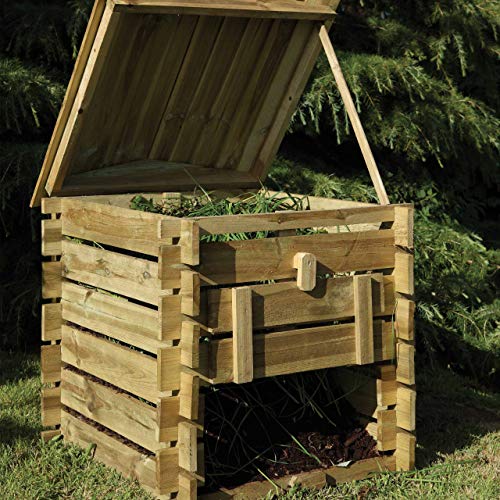
7. Forest Garden Pressure Treated Wooden Beehive Composter – Best Wooden
Type: Wooden static bin | Material: Pressure-treated timber | Best for: Cottage gardens and traditional plots
A beehive composter is the bin to choose when looks matter. Forest Garden is one of the UK’s best-known garden timber brands, and its beehive composter is made from pressure-treated wood with stacking tiers and a lid, so it looks at home in a cottage garden or traditional veg plot.
Wooden bins breathe well, which helps aeration, but they lose heat quickly, so expect a similar timescale to the Blackwall – around 9–12 months for finished compost. Stack or lift the tiers to get at the compost, and treat the wood every year or so to help it last.
Pros
- Attractive in traditional gardens
- Pressure-treated timber for longer life
- Good natural aeration
Cons
- Slower than tumblers and hot bins
- Timber will eventually need replacing
- Not suitable for cooked food
How to Choose the Right Compost Bin
Match the bin to your garden size
For a small garden producing mostly kitchen scraps, a wormery or HOTBIN Mini will do the job without dominating the space. For a typical family garden with a lawn and borders, a 200–220 litre static bin or a dual-chamber tumbler is the sweet spot. For allotments or big plots, consider two or three Blackwall converters side by side, or a full-size HOTBIN if you want faster results.
Cool, warm or hot – what’s the difference?
Cool composting (static plastic and wooden bins) is slow and forgiving: add material whenever you have it and expect finished compost in 9–12 months. Tumblers speed things up by keeping the heap mixed and aerated, often producing compost in a couple of months in summer. Hot composting (the HOTBIN range) runs much hotter, works year round and can handle cooked food.
Watch out for cooked food
Standard bins, tumblers and wooden composters shouldn’t take cooked food, meat, fish or dairy – it attracts rats and can turn the heap smelly. If cutting food waste is your main goal, a hot composter like the HOTBIN is the right choice.
Check for council subsidies
Many UK councils offer subsidised compost bins, often the Blackwall converter, through home-composting schemes. It’s worth a quick look at your council’s website before you buy.
Frequently Asked Questions
Where should I put my compost bin?
On bare soil if you can, in a spot that gets some sun but isn’t baked all day. Bare soil lets worms and microbes move in. A part-shaded corner near the kitchen door is ideal – close enough that you’ll use it, but not right in front of the patio.
What can I put in a compost bin?
A mix of “browns” (cardboard, shredded paper, dry leaves, straw) and “greens” (fruit and veg peelings, grass clippings, soft prunings, coffee grounds and plastic-free tea bags). Aim for roughly two parts brown to one part green by volume. Keep cooked food, meat, fish, dairy and pet waste out of standard bins.
How long does compost take to make?
It depends on the bin and the season. A hot composter is the fastest, a well-managed tumbler can produce compost in a couple of months in summer, and a static plastic or wooden bin usually takes 9–12 months. UK winters slow everything down except hot composters.
Is composting worth it in a small garden?
Absolutely. Even a small wormery keeps a surprising amount of food waste out of your bin and produces a steady supply of castings for pots and tomatoes. If you only have a balcony or courtyard, a wormery is the answer.
Final Verdict
Our overall pick is the HOTBIN. It isn’t the cheapest bin, but it composts faster, works through winter and takes food waste other bins can’t. If you’re starting out on a budget, the Blackwall 220L Compost Converter is brilliant value, especially if your council subsidises it. For courtyards and balconies, the Wormcity wormery is a great all-in-one starter kit.
Whichever bin you choose, the most important thing is to start. Even an imperfect compost bin beats a wheelie bin full of peelings, and the soil you’ll build over the next few years will more than repay the cost.
You might also like our guides to the best water butts and best wheelbarrows on MyGreenShed.