Every garden produces waste that is awkward to deal with: thorny prunings the council green bin will not take, diseased plant material you should not compost, and the endless dry debris of an autumn tidy-up. A garden incinerator turns all of it into a small pile of ash in an hour or two, which is hard to argue with on a clear, still day.
A good incinerator is essentially a galvanised steel bin with ventilation holes that let air feed the fire from below, so material burns hot and fast rather than smouldering. The comparison covers best garden incinerators for 2026 across every size, from a compact bin for a small plot to a vast 180-litre drum for serious clearing.
What to look for in a garden incinerator
Capacity for your garden
Incinerators range from around 15 litres up to 180 litres. A small 15 to 56-litre bin is plenty for a modest garden and easy to store, while 90 litres is the popular all-round size for most households. Only go for a 125 to 180-litre drum if you regularly clear large amounts, as a big incinerator is heavy and takes up a lot of shed space.
Galvanised steel and build quality
Galvanised steel resists rust and stands up to repeated high heat far better than painted steel, so it is what you want. Even so, the metal will degrade over years of hot fires, and a thicker gauge lasts longer. Check the seams and base, as these take the most punishment and are the first places a cheap incinerator burns through.
Ventilation and the lid
Good airflow is what makes the difference between a roaring, efficient burn and a smoky smoulder. Look for at least two rows of ventilation holes around the base and a funnel or chimney-style lid that creates an updraught to draw the fire upward. The lid also keeps embers contained and stops the wind scattering sparks.
Legs and stability
Most incinerators stand on three legs, which lifts the base off the ground to protect your lawn or patio and improves airflow underneath. Stable, sturdy legs matter, because a wobbling drum full of burning material is genuinely dangerous. A lid clip or locking handle is a useful safety feature on windier sites.
The best garden incinerators for 2026
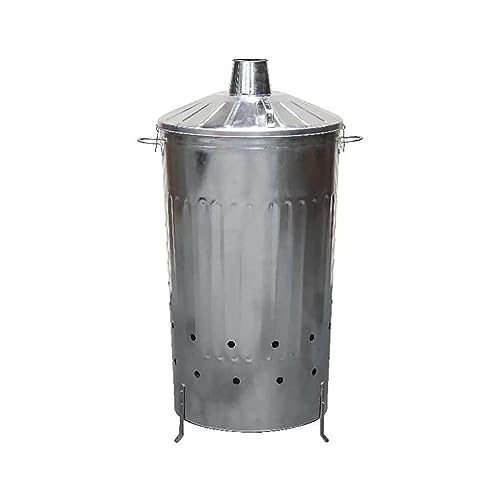
1. simpa 180L XXL Galvanised Incinerator with Locking Lid – best for large gardens
For big gardens, smallholdings and anyone who clears a lot of waste, the simpa 180-litre incinerator is a proper workhorse. Its galvanised steel body and locking lid are built for heavy clearing, and the sheer capacity means fewer trips back and forth with armfuls of prunings.
It is heavy and needs space to store, so it is overkill for a small plot, but if you regularly tackle hedge clearings, allotment waste or a large autumn tidy, nothing here will get through the job faster.
Key specs: 180L capacity; galvanised steel; locking lid; ventilation holes for a hot burn Pros: – Huge capacity – Locking lid keeps embers contained – Burns fast and hot – Good value for the size
Cons: – Bulky to store – Far more than a small garden needs
Best for: Large gardens and smallholdings
2. CrazyGadget 90L Galvanised Incinerator – best mid-range all-rounder
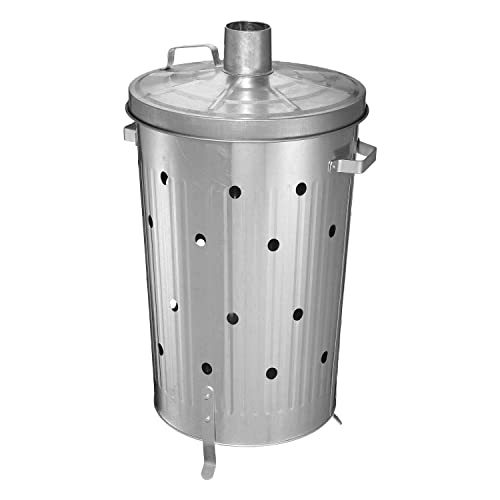
The 90-litre size is the sweet spot for most households, and the CrazyGadget is a well-known example. It has a galvanised body, a good spread of ventilation holes, a special locking lid and a stable three-legged base, ticking all the boxes for everyday garden burning.
This is the incinerator we would recommend to most people: big enough to be useful, small enough to store in a shed corner, and sensibly priced. The locking lid is a genuine safety plus on breezier days, keeping embers contained while the fire does its work.
Key specs: 90L capacity; galvanised steel; locking lid; greater ventilation for rapid burn Pros: – Ideal all-round size – Locking lid – Stable base – Sensible price
Cons: – Still needs some storage space – Mid-weight to move when not in use
Best for: All-round household use

3. Denny International 90L Fire Incinerator – best value
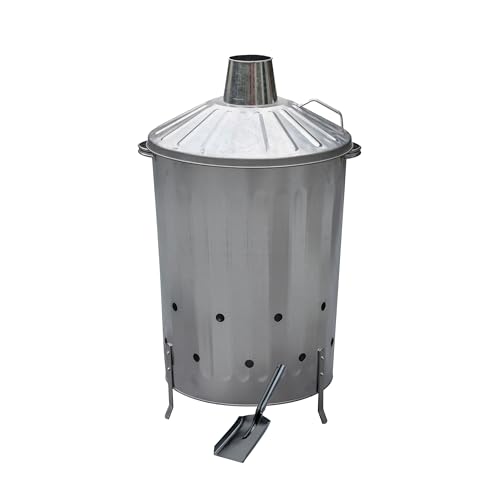
Another strong 90-litre option, the Denny International incinerator has a loyal following among gardeners who burn regularly. Owners report getting through many fires with no sign of burn-through, which is exactly the durability you want from galvanised steel at this price.
It typically undercuts many rivals while matching them for build. The ventilation holes run high up the body and the lid funnels the heat upward nicely. If you want a dependable, no-nonsense 90-litre bin and do not need a particular brand, this is a smart, economical pick.
Key specs: 90L capacity; galvanised steel; fast-burn ventilation holes; funnel lid Pros: – Proven durability – Keenly priced – Good ventilation – Dependable
Cons: – Plain design – Lid fit can be a little loose on uneven ground
Best for: Best value 90L
4. simpa 90L Galvanised Incinerator – best widely available 90L
If you would rather buy from a familiar brand that is also stocked in high-street stores such as B&Q, the simpa 90-litre galvanised incinerator is a solid, widely available choice. It offers the same galvanised-bin-with-vents design as pricier rivals, with a lid that helps contain embers.
It is a straightforward option, but it does the core job perfectly well, and wide availability counts for a lot when you have a pile of waste and a forecast of dry weather. Assembly is simple, with the legs and handles fitting in minutes.
Key specs: 90L capacity; galvanised steel; three-legged base; lid with ventilation Pros: – Familiar brand with wide availability – Simple assembly – Good all-round size – Sensible price
Cons: – Basic build – Thinner gauge than heavy-duty drums
Best for: Buyers who want a widely stocked 90L bin
5. Draper 15L Galvanised Mini Incinerator – best for small gardens
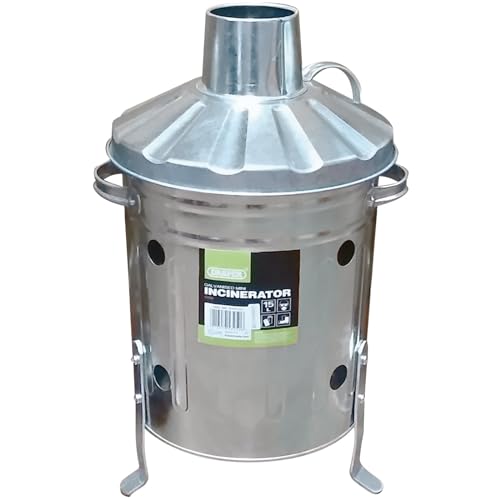
Not everyone needs a giant drum. For a small garden, courtyard or compact plot, a 15-litre incinerator handles modest amounts of dry waste and tucks away easily afterwards. The Draper GMI mini incinerator does this well.
It will not get through a hedge’s worth of clippings in one go, but for the steady trickle of dry prunings and debris a small garden produces, it is ideal and far easier to store than a full-size bin. Burn little and often and it earns its keep.
Key specs: 15L capacity; galvanised steel; compact footprint Pros: – Compact – Easy to store – Trusted tool brand – Perfect for small gardens
Cons: – Limited capacity – Frequent emptying for bigger jobs
Best for: Small gardens
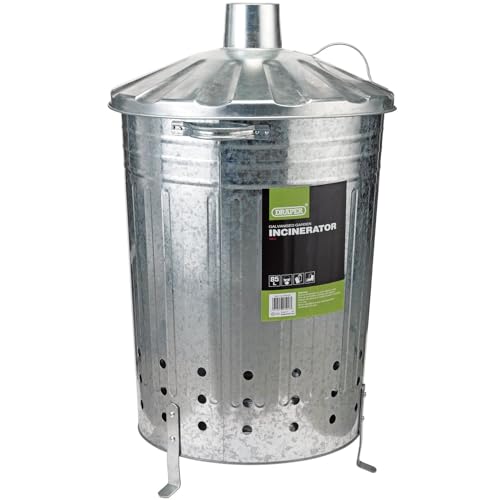
6. Draper 85L Galvanised Garden Incinerator – best premium build
If you want something built to last, the Draper 85-litre galvanised incinerator comes from a brand known for tough tools and should shrug off years of regular burning when looked after. It sits at the premium end of the mid-size bins.
The 85-litre capacity is a good middle ground between the compact bins and the huge 180-litre drums, suiting most medium gardens. Sturdy legs and a well-fitting lid make it a pleasure to use, and Draper’s reputation adds confidence.
Key specs: 85L capacity; galvanised steel; lid with vents; three-legged base Pros: – Trusted brand – Sensible mid-size capacity – Solid lid and handles – Built to last
Cons: – Premium price for the size – Smaller than a 90L bin from budget rivals
Best for: Durability and medium gardens
Garden incinerators compared
|
Incinerator |
Capacity |
Price |
Best for |
|
simpa 180L |
180L |
See card for current price |
Large gardens, heavy clearing |
|
CrazyGadget 90L |
90L |
See card for current price |
All-round household use |
|
Denny International 90L |
90L |
See card for current price |
Best value 90L |
|
simpa 90L |
90L |
See card for current price |
Widely available 90L |
|
Draper 15L Mini |
15L |
See card for current price |
Small gardens |
|
Draper 85L |
85L |
See card for current price |
Durability, medium gardens |
Burning garden waste safely and responsibly
Only burn dry garden material such as woody prunings, twigs and dead leaves. Wet or green material smoulders and produces thick smoke, while burning household rubbish, plastics or treated wood is harmful and, in many cases, illegal. Let clippings dry out for a week or two before burning.
Be considerate of neighbours. There is no fixed law against garden bonfires, but causing a persistent smoke nuisance can lead to action from your council. Pick a dry, still day, avoid weekends and washing-line afternoons, and never leave a fire unattended.
Site the incinerator on bare earth or paving, well away from fences, sheds, hedges and overhanging branches. Keep a bucket of water or a hose nearby, and let the ash cool completely before disposing of it. Cooled wood ash, in moderation, can even go on the compost heap or around certain plants.
Store the incinerator under cover or beneath a waterproof sheet between uses. Galvanised steel resists rust well, but keeping rain off it and emptying out ash promptly will add years to its life.
Our verdict
For the majority of gardens, a 90-litre incinerator is the right call, and the CrazyGadget and Denny International models both offer dependable galvanised builds at a fair price. The simpa 90L is the one to consider if you want a widely stocked brand you can also find on the high street. Clearing a large plot or smallholding? The simpa 180L makes short work of substantial waste volumes, while the Draper 15L mini suits a small garden that only produces a trickle of dry waste.