Dandelions, clover, daisies and
creeping buttercup can take over a British lawn surprisingly fast. The good
news is that the right lawn weed killer will clear them out without harming the
grass – as long as you pick a selective product and apply it at the
right time of year.
Below are seven of the best options on
Amazon UK, from powerful concentrates for whole-lawn problems to ready-to-use
sprays for the odd dandelion, weed-and-feed granules, and a chemical-free tool
for pet owners.
Quick Picks
•
Best overall: Resolva Lawn Weedkiller Extra Concentrate
•
Best ready-to-use: Weedol Lawn Weedkiller Ready to Use
•
Best weed and feed: Aftercut All in One Lawn Feed, Weed & Moss Killer
•
Best for moss: Vitax Feed, Weed & Moss Killer
•
Best liquid feed and weed: Vitax Feed & Weed Concentrate
•
Best budget concentrate: Doff Concentrated Lawn Weedkiller
•
Best chemical-free option: Fiskars Xact Weed Puller
How Lawn Weed Killers
Work
Selective lawn weed killers target
broadleaf weeds – dandelions, plantains, clover, daisies and buttercup – but
leave narrow-leaved grasses alone. Common actives on UK home-garden labels
include mecoprop-P, dicamba and MCPA, often blended for broader weed control.
Total weed killers – based on
glyphosate, pelargonic acid or acetic acid – kill everything they touch, grass
included. They’re for patios, paths and driveways, never lawns. Always
check the label says “lawn” or “kills weeds, not lawns”
before you spray.
Pesticide approvals change, so always follow the current product
label and check the HSE approvals database if you’re unsure.
The 7 Best
Lawn Weed Killers UK 2026
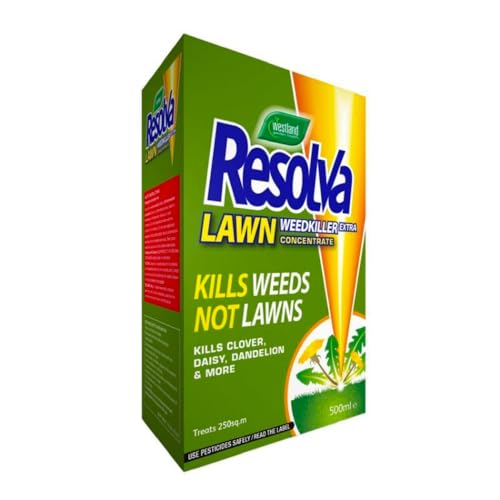
1. Resolva Lawn
Weedkiller Extra Concentrate – Best Overall
Type: Selective concentrate (dilute and
spray) | Size: 500 ml | Actives:
Mecoprop-P and dicamba | Coverage: Around 250 m² (50 ml per
25 m²)
If
you have a serious lawn weed problem – a clover-covered front lawn, persistent
dandelions or sheets of creeping buttercup – Resolva Lawn Weedkiller Extra is
one of the strongest selective concentrates you can buy for home use. It
controls clover, daisies, buttercup and dandelions, with moderate control of
tougher weeds such as docks, nettles and thistles.
Mix
with water and apply with a watering can or pressure sprayer. It works
gradually: expect the weeds to twist and distort over a couple of weeks before
dying off completely. Apply on a dry day when the lawn is actively growing, and
wait at least a day before mowing.
Pros
•
Very effective on common lawn
weeds
•
Good value per square metre
•
Pets and children can return
once the treated area is dry
Cons
•
Needs careful measuring and
mixing
•
Slow-acting – clover may need a
second treatment

2. Weedol Lawn
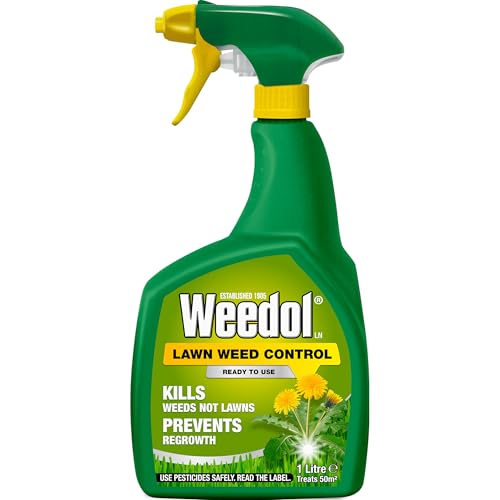
Weedkiller Ready to Use – Best Ready-to-Use
Type: Ready-to-use selective spray
| Size: 1 L | Best for: Small lawns and
spot treatments
Weedol’s
ready-to-use lawn weedkiller is the simplest way to deal with a handful of lawn
weeds. There’s no mixing, no measuring and no sprayer to clean – just
spot-treat the dandelion and walk away. It’s a great “lawn first-aid
kit” to keep in the shed through the season.
It’s
poor value for a whole lawn full of weeds – you’ll get through bottles fast –
but for small lawns and odd weeds it’s hard to beat. Keep children and pets off
the lawn until the spray has completely dried.
Pros
•
No mixing or measuring
•
Quick to use for spot
treatments
•
Reliable on common broadleaf
weeds
Cons
•
Expensive per square metre for
big lawns
3. Aftercut All
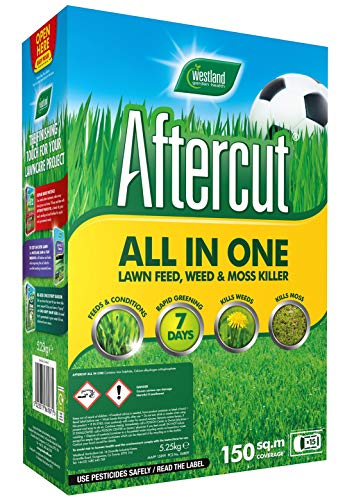
in One Lawn Feed, Weed & Moss Killer – Best Weed and Feed
Type: Granular feed, weed and moss
treatment | Size: 5.25 kg | Coverage: 150
m²
Westland’s
Aftercut All in One is one of the most popular lawn products in the UK because
it does three jobs at once: the fertiliser greens up the grass, the moss killer
blackens moss, and the selective weed killer tackles broadleaf weeds. Apply
with a spreader for an even finish.
It’s
the right choice if your lawn is generally tired and patchy rather than badly
weed-infested. Weed control is decent rather than savage, but you get a feed
thrown in. It’s also available in larger packs for bigger lawns.
Pros
•
Three-in-one convenience
•
Visibly greens up the lawn
•
Widely available in several
pack sizes
Cons
•
Not as strong on weeds as a
dedicated concentrate
•
Moss-killing iron can stain
paving – sweep up any stray granules
4. Vitax Feed,
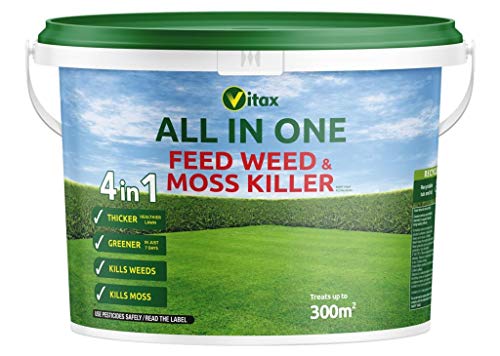
Weed & Moss Killer – Best for Moss
Type: Granular feed, weed and moss
treatment | Coverage: 300 m²
If
moss is your main problem and weeds are a secondary issue, Vitax’s granular
Feed, Weed & Moss Killer is a strong choice. It treats a generous 300
square metres, so it’s good value for bigger or shadier lawns where moss
thrives.
The
moss turns black within days and then dies. Rake it out after a couple of weeks
and you’ll have a noticeably cleaner, greener lawn – the ideal starting point
for overseeding in spring or autumn.
Pros
•
Effective on moss
•
Feeds and weeds at the same
time
•
Large 300 m² coverage
Cons
•
Lawn can look blackened for a
week or two
•
Can stain paths and patios
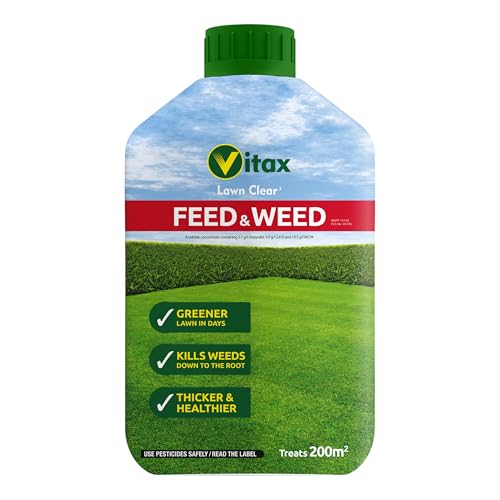
5. Vitax Feed
& Weed Concentrate – Best Liquid Feed and Weed
Type: Liquid feed and selective weed
killer concentrate | Size: 1 L | Coverage:
200 m²
Not
a fan of spreading granules? Vitax Feed & Weed does the same two jobs in
liquid form. Dilute it in a watering can or sprayer and it feeds the grass
while killing clover, buttercup, dandelions and daisies.
Liquid
feeds are absorbed quickly, so the lawn greens up fast, and a watering can
gives you an even application without buying a spreader. It’s a great option
for small to medium lawns.
Pros
•
Feeds and weeds in one
application
•
No spreader needed
•
Kills common broadleaf weeds
Cons
•
No moss control
•
More work to apply over a large
lawn
6. Doff
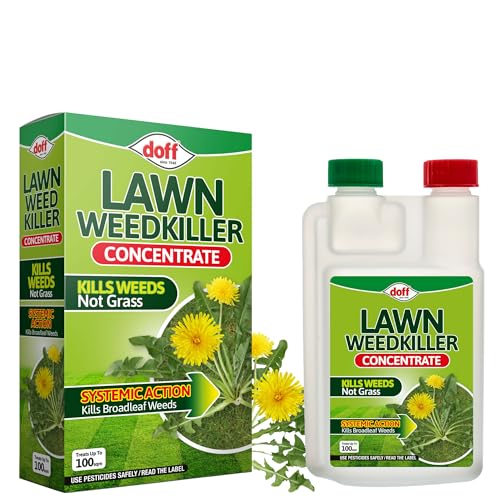
Concentrated Lawn Weedkiller – Best Budget Concentrate
Type: Selective concentrate
| Size: 200 ml | Best for:
Budget-conscious gardeners
Doff
has been making UK garden products for decades, and its concentrated lawn
weedkiller is an affordable way to treat a whole lawn. Dilute in water, apply
with a watering can or sprayer, and it tackles rooted broadleaf weeds on lawns
and grassy areas.
It’s
a smaller bottle than the Resolva, so it’s ideal for small to medium lawns or a
single season’s treatment.
Pros
•
Low cost of entry
•
Selective – kills weeds, not
grass
•
Compact bottle is easy to store
Cons
•
Smaller bottle – bigger lawns
will need more than one
•
Needs measuring and mixing
7. Fiskars Xact
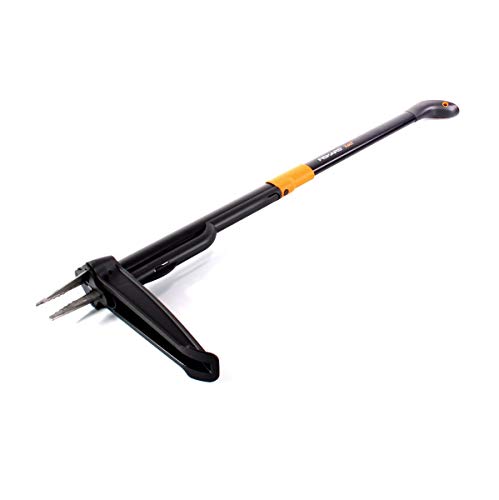
Weed Puller – Best Chemical-Free Option
Type: Stand-up weed puller |
Length: 1 m | Best for: Pet households and
chemical-free lawns
If
you’d rather not use chemicals at all – because dogs, cats or small children
use the lawn, or you simply prefer to garden organically – a good weed puller
is the answer. The Fiskars Xact lets you pull dandelions and other tap-rooted
weeds out, root and all, without bending or kneeling. Push the stainless steel
claws into the soil over the weed, lever back, and eject the weed with the
handle.
It
won’t clear a lawn carpeted in clover, but for dandelions, plantains and dock
seedlings dotted across the grass, it’s quick, satisfying and completely
chemical-free.
Pros
•
No chemicals – safe for pets
straight away
•
Removes the whole root
•
No bending or kneeling
Cons
•
Not practical for widespread
weeds or clover
•
Leaves small holes – top up
with soil and seed if needed
Comparison Table
|
Product |
Format |
Coverage |
Best for |
|
Resolva Lawn Weedkiller Extra |
Concentrate (500 ml) |
~250 m² |
Heavy weed problems |
|
Weedol Lawn Weedkiller RTU |
Ready to use (1 L) |
Spot treatment |
Small lawns, odd weeds |
|
Aftercut All in One |
Granular (5.25 kg) |
150 m² |
Tired, patchy lawns |
|
Vitax Feed, Weed & Moss Killer |
Granular |
300 m² |
Mossy lawns |
|
Vitax Feed & Weed |
Liquid concentrate (1 L) |
200 m² |
Feed and weed without a spreader |
|
Doff Concentrated Lawn Weedkiller |
Concentrate (200 ml) |
Check label |
Budget whole-lawn treatment |
|
Fiskars Xact Weed Puller |
Manual tool |
Per weed |
Pet households, chemical-free |
Compare live prices and ratings:
Invalid table id.
How to
Choose the Right Lawn Weed Killer
Match the product to the problem. A few isolated dandelions need a
spot treatment (Weedol Ready to Use) or a weed puller (Fiskars Xact). A
whole-lawn weed problem needs a concentrate (Resolva or Doff). A tired, mossy,
weedy lawn benefits from a weed and feed (Aftercut or Vitax). If pets use the
lawn, go chemical-free, or keep them off treated areas for as long as the label
says.
Lawn size matters for value too. On lawns under about 50 m², a
ready-to-use spray often makes more sense than a concentrate you won’t finish.
On bigger lawns, a concentrate or granular weed and feed works out far cheaper
per square metre.
When to
Apply Lawn Weed Killer in the UK
Selective weed killers work best when weeds are actively growing –
roughly mid-April to early September in the UK. The best windows are late
spring (May), when weeds are growing fast, and early autumn
(September).
Avoid the hottest, driest weeks of summer: drought-stressed weeds
don’t absorb herbicide well, and you risk scorching the grass. Don’t apply if
rain is forecast within the label’s rain-free period, and avoid mowing for a
few days before and after treatment so the weeds have plenty of leaf to absorb
the product.
How to Apply Safely
Wear gloves when mixing concentrates, and keep a dedicated watering
can for weed killer – never use the one you water edible plants with. Apply on
a still day to avoid drift onto borders, and keep children and pets off the
treated area until it has fully dried (or longer if the label says so).
Don’t treat a newly sown or turfed lawn until it’s well established
– check the label for the minimum age. Don’t put the first few mowings after
treatment on your compost heap, or use them as mulch; check the label for how
to dispose of them.
FAQs
Will lawn weed killer
kill my grass?
Not if you use a
selective lawn weed killer as directed – they’re designed to kill broadleaf
weeds and leave grass unharmed. Never use a total weed killer such as
glyphosate or pelargonic acid on a lawn.
Is lawn weed killer safe for dogs?
Most selective lawn weed
killers say to keep pets off the treated area until it has dried, but always
follow the label. If you want zero chemical exposure, use a manual weed puller
like the Fiskars Xact instead.
How long does
lawn weed killer take to work?
Selective weed
killers are systemic, so they work slowly. You’ll usually see weeds twisting
and yellowing within one to two weeks, with full die-off over the following few
weeks.
Should I use
weed and feed or a separate weed killer?
Weed and feed is
ideal for tired lawns with a light to moderate weed problem. For a lawn that’s
heavily infested, a dedicated selective concentrate is more effective.
Final Verdict
For most UK gardeners with a real weed problem, Resolva Lawn
Weedkiller Extra Concentrate offers the best balance of strength and value.
For one-and-done convenience, Aftercut All in One feeds the grass and
kills moss as well as weeds. For the odd dandelion, grab a bottle of Weedol
Ready to Use – and if you’d rather avoid chemicals altogether, the Fiskars
Xact Weed Puller does a brilliant job.
Whichever
you choose, apply it at the right time of year and follow the label, and your
lawn will be weed-free within a few weeks.
Related Reading
•
Best Lawn Feed UK 2026 – feed
alongside or instead of a weed and feed.
•
Best Lawn Aerator UK 2026 – relieve compaction so a healthy lawn outcompetes weeds.
•
How to Scarify Your Lawn – clear thatch and moss for healthier turf.
•
Best Grass Seed UK 2026 – repair bare patches left after weed treatment.