Scattering fertiliser by hand gives uneven coverage: dark green stripes and pale yellow gaps that show up a few weeks later. A spreader puts granular fertiliser, grass seed and autumn treatments down evenly. Late August through September is the key window for autumn feeding, overseeding and post-scarification repair.
Quick Verdict Summary
- Overall pick for typical gardens: The Handy THS50 23kg Push Broadcast Spreader
- Budget choice: Scotts EverGreen Handy Spreader
- Precision/narrow lawns: Wolf-Garten WE 430 Drop Spreader
- Large lawns: The Handy THS125HDUTY 56kg Heavy-Duty Spreader
- Cordless option: Einhell GE-US 18 Li-Solo Universal Spreader (see product notes below)
Broadcast, Drop or Handheld? Choose the Type First
Broadcast (Rotary) Spreaders
A spinning disc throws granules in an arc 2-4 metres wide. These suit lawns above about 150 square metres. The trade-off is precision: granules can land on borders and paths unless you leave a buffer, and weed-and-feed overspill can harm border plants.
Drop Spreaders
Material drops straight down between the wheels, so nothing lands where you do not want it. That precision suits small, irregular lawns with lots of edges and is essential when applying moss killer or weed-and-feed near planted areas. The downsides are slower going and the need for carefully overlapped passes to avoid visible stripes.
Handheld Spreaders
A hopper with a hand crank suits lawns up to roughly 100 square metres or patch repairs. Storage is easy and cost is low, but consistency depends on a steady walking and cranking speed, which is why wheeled units are more reliable.
The Best Lawn Spreaders in the UK for 2026
1. Scotts EverGreen Handy Spreader — Best Budget Buy
A simple handheld with a sliding gate for flow control. It covers a small lawn in about ten minutes of steady walking. The plastic is thin and the crank has some play, so treat it as a consumable rather than a long-term investment.
Key specs: handheld, hand-crank, sliding gate flow control. See card for current price.
Pros: – Cheapest way to stop hand-scattering – Minimal storage footprint – Handy for overseeding bare patches
Cons: – Flimsy construction – Evenness depends on a consistent walking pace – Frequent refilling on anything but a small lawn
Best for: Lawns under about 80 square metres, or a second spreader for patch repairs.
No products found.
2. Gardena Spreader M — The Better Handheld
An upgraded handheld with better plastics, a smoother mechanism and a more predictable flow rate. Gardena supplies replacement parts, as it does across its range. It is still hand-cranked so the consistency caveats apply, but it feels noticeably more refined.
Key specs: handheld, hand-crank, spreading width about 1-4m, suited to lawns up to about 100 square metres. See card for current price.
Pros: – Sturdy for the price – Smoother, more consistent delivery – Comfortable weight distribution when full
Cons: – Limited hopper capacity – Costs noticeably more than the Scotts while still hand-cranked
Best for: Small to medium lawns where storage space is tight.

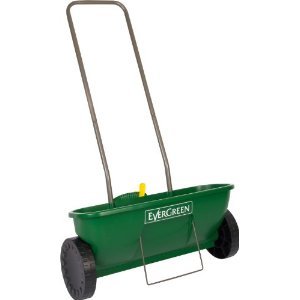
3. Scotts EverGreen Easy Spreader Plus — The Entry-Level Push Spreader
The logical first wheeled upgrade and widely available. Pushing turns the spinning plate through the wheels, and a handle lever shuts off the flow at the end of each pass. Scotts publishes calibration settings for its own products, which cuts the guesswork.
Key specs: push broadcast, wheel-driven, handle shut-off lever. See card for current price.
Pros: – Wheeled spreading at a budget price – Integrated handle shut-off – Published settings for Scotts products
Cons: – Lightweight plastic wheels struggle on rough or waterlogged ground – Small hopper means several refills on bigger lawns
Best for: Medium lawns up to about 200 square metres on reasonably even ground.
4. Wolf-Garten WE 430 Drop Spreader — Best for Precision
A 43cm drop spreader with a 20-litre hopper, part of Wolf-Garten’s interchangeable handle system. Vertical release keeps granules off borders, making it ideal for weed-and-feed or moss killer near planted beds.
Key specs: drop spreader, 43cm width, 20-litre hopper. See card for current price.
Pros: – No overspill onto borders and paths – Consistent, repeatable application – Well built and corrosion-resistant
Cons: – Slower on large lawns – Careful pass overlap needed to avoid stripes – Costs more than broadcast spreaders with a similar hopper
Best for: Small and medium lawns with lots of edges; anyone applying weed-and-feed.
No products found.
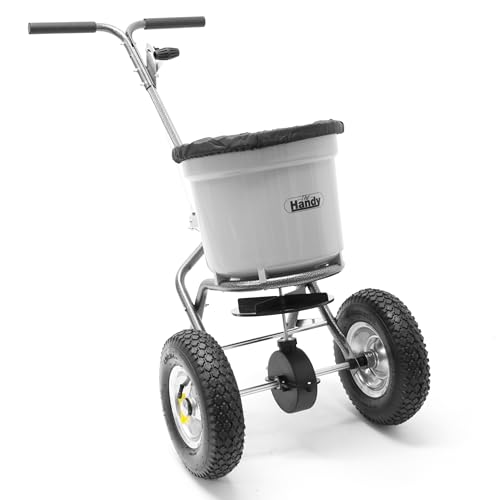
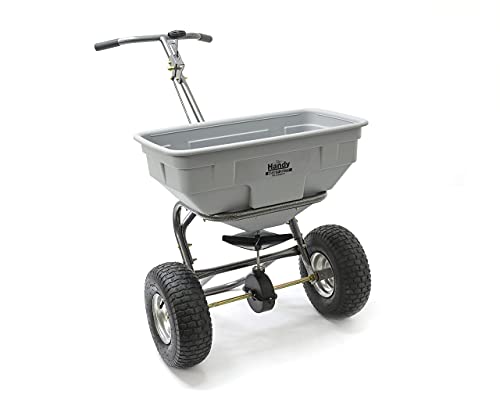
5. The Handy THS50 23kg Push Broadcast Spreader — Best Overall
The best choice for a typical UK back garden that has outgrown a handheld. The 23kg hopper usually covers a whole lawn in one fill, and pneumatic tyres cope with uneven turf and soft autumn ground better than the plastic wheels on budget models. The adjustable feed control stays put once set.
Key specs: push broadcast, 23kg hopper, pneumatic tyres, metal handle. See card for current price.
Pros: – Pneumatic tyres handle soft ground well – Hopper size avoids constant refilling – Sturdy metal handle – Sensible value
Cons: – Needs assembling on delivery – No standard side deflector, so leave a buffer near borders
Best for: Lawns of roughly 200-600 square metres.
6. Einhell GE-US 18 Li-Solo Universal Spreader — Best Cordless
A handheld spreader that swaps the hand crank for a motor. The 3.3-litre hopper is compact, but the 18V motor keeps the disc speed constant whatever your walking pace, removing the main source of unevenness in manual spreading. Spread width adjusts from 2.2m to 5m with six speed and eight volume settings. Einhell rates it for 800 square metres, though you will refill often at that size.
Key specs: 18V Power X-Change (battery and charger not included), 3.3-litre hopper, 2.2-5m spread width, 6 speed and 8 volume settings.
Pros: – Much more consistent than hand-crank spreaders – Useful for winter salt as well as feed and seed – Practical if you already own Power X-Change batteries
Cons: – Small hopper – Bare-unit pricing is misleading without an existing battery – Wheeled spreaders are better for large areas
Best for: Existing Einhell owners; anyone who finds hand-cranking difficult.
7. The Handy THS125HDUTY 56kg Heavy-Duty Spreader — Best for Large Lawns
A big-hopper spreader with a wide broadcast arc and pneumatic tyres, built for large gardens, smallholdings and winter grit. It is heavy when loaded, so you need level ground and some pushing strength, but the time saved on a genuinely large lawn is substantial.
Key specs: push broadcast, 56kg hopper, pneumatic tyres. See card for current price.
Pros: – Enormous hopper capacity – Wide, even spread arc – Commercial-grade build
Cons: – Heavy and unwieldy when full – Too much for an average garden with limited storage – Highest price in this selection
Best for: Lawns over about 800 square metres, or shared use across several properties.
Worth knowing: If you own a ride-on mower or garden tractor, a tow-behind spreader such as those from Agri-Fab may suit you better, as it removes the pushing altogether.
At a Glance
|
Model |
Type |
Hopper |
Suits Lawn Size |
Price |
|
Scotts EverGreen Handy Spreader |
Handheld |
Small |
Up to 80 sq m |
See card for current price |
|
Gardena Spreader M |
Handheld |
Small |
Up to 100 sq m |
See card for current price |
|
Scotts EverGreen Easy Spreader Plus |
Push broadcast |
Medium |
Up to 200 sq m |
See card for current price |
|
Wolf-Garten WE 430 |
Push drop |
20 litre |
Up to 250 sq m |
See card for current price |
|
The Handy THS50 |
Push broadcast |
23 kg |
200-600 sq m |
See card for current price |
|
Einhell GE-US 18 Li-Solo |
Cordless handheld |
3.3 litre |
Up to 800 sq m |
Bare unit; battery extra |
|
The Handy THS125HDUTY |
Push broadcast |
56 kg |
800 sq m plus |
See card for current price |
How to Get an Even Spread
- Calibrate before starting: Check the manufacturer’s settings for your product. If none are published, test on a hard surface at a low gate setting, measure what comes out and adjust. Under-applying twice beats over-applying once.
- Split the dose into perpendicular passes: Apply half the rate north to south, then half east to west. It is the single most effective trick for hiding any unevenness.
- Keep a steady walking pace: Speed changes alter the application rate on every wheeled spreader. Pick a comfortable pace and hold it. Close the gate before stopping, turning or reversing.
- Do the edges first: Make one perimeter pass before filling in the middle. It gives you a turning strip and stops granules drifting into borders.
- Water after application: Unless rain is forecast, water in granular autumn feeds. Most need moisture to activate, and undissolved granules on dry grass can scorch.
- Clean the spreader straight after use: Fertiliser corrodes mechanisms and seizes spreaders stored damp with granules inside. Rinse and dry immediately.
Autumn Timing for UK Lawns
Late August through October is the prime application season. Autumn formulations are higher in potassium and phosphate and lower in nitrogen, toughening grass for winter rather than encouraging soft, frost-prone growth. Spring or summer feeds are not suitable for autumn use.
After scarifying or aerating, feed and overseed straight away while the thinning and perforations give seed good soil contact. September’s warm soil gives better overseeding establishment than spring sowing. See our guides to scarifying and aerating for more on timing.
Weed-and-feed caution: These products need actively growing weeds to work, and perform far better in spring than in October. In autumn, prioritise feeding to thicken the sward and leave weed control until spring.
Frequently Asked Questions
Can I use a lawn spreader for grit and rock salt in winter?
Broadcast spreaders handle salt well, but salt is corrosive, so wash and dry the spreader thoroughly the same day. Drop spreaders are unsuitable for salt because the narrow outlets clog easily.
Do I really need one for a small lawn?
Lawns under about 50 square metres can be scattered carefully by hand. However, a handheld spreader costs about the same as one box of fertiliser and gives much better evenness, so it pays for itself by preventing scorch on the first application.
Broadcast or drop for a lawn with lots of borders?
A drop spreader is the better fit, or use a broadcast spreader with two-metre buffer strips and fill those in afterwards with a handheld. Weed-and-feed granules landing in borders damage plants.
Why is my lawn striped after feeding?
Uneven pass overlap is almost always the cause: too much gap leaves pale stripes, too little leaves dark bands. Spreading at half rate in two directions at right angles fixes it next time, and visible stripes fade within a few weeks.
Our Verdict
For typical UK gardens, The Handy THS50 is the right choice: pneumatic tyres, a hopper that covers the lawn in one fill, and a fair price for equipment used twice a year for a decade. Small, irregularly edged lawns suit the Wolf-Garten WE 430 for its accuracy. Budget-conscious gardeners who want to stop hand-scattering this autumn should buy the Scotts EverGreen Handy Spreader, which does more for the lawn than any other purchase at that price.