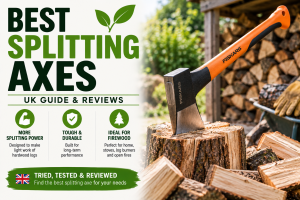
A splitting axe is one of the few garden tools where a good one and a bad one feel like different activities. The wrong axe bounces, sticks, jars your wrists and makes a two-hour job feel like a punishment. The right one drops through a seasoned round of ash with a single swing and leaves you wondering why you ever hired anything.
With the log pile going in for winter, this is the tool worth getting right. Below we have set out what actually separates a splitting axe from a felling axe from a maul, and which ones are worth your money in the UK this year.
Quick verdict
- Best overall for most people: Fiskars X25 splitting axe (around £60-75)
- Best budget option: Draper 94987 fibreglass splitting axe (around £25-35)
- Best for big rounds: Fiskars X27 super splitting axe (around £70-90)
- Best traditional wooden-handled axe: Hultafors Agdor splitting axe (around £70-90)
- Best for life: Gransfors Bruk splitting maul (around £190-230)
- Best for kindling: Fiskars X7 hatchet (around £35-45)
Splitting axe, felling axe or maul?
These get sold interchangeably and they are not the same tool at all.
Felling axe
A thin, sharp head designed to cut across the grain, which is what you do when you fell a tree or limb a trunk. Use one on a log round and it will bury itself and stop dead, because it is designed to slice rather than wedge. If you already own an axe and it keeps getting stuck, this is almost certainly why.
Splitting axe
A wedge-shaped head, typically 1.5 to 3kg, designed to force the grain apart rather than cut it. The convex cheeks push the halves away as the head enters, which is what stops it sticking. This is the tool for ordinary firewood, and for the great majority of UK gardeners it is the only one needed.
Splitting maul
Much the same shape but far heavier, usually 3 to 4kg, often with a sledgehammer face on the back for driving wedges. Pure mass. It parts big, gnarly rounds that a lighter axe bounces off, but it is exhausting over an afternoon and unnecessary on wood under about 30cm.
Modern composite-handled splitting axes have blurred this line considerably. A Fiskars X27 at 2.6kg splits nearly as well as a traditional 3.5kg maul, because the head geometry and the handle length do work that used to be done by sheer weight.
The best splitting axes and mauls in the UK
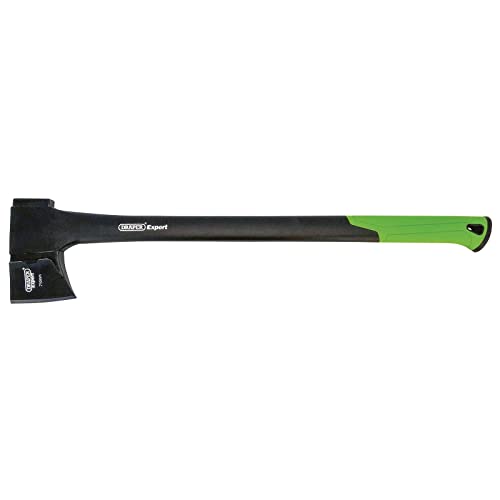
1. Draper 94987 fibreglass splitting axe – best budget buy
Around £25-35. Every builders’ merchant sells a version of this: a forged head on a fibreglass shaft with a rubber grip, usually around 1.8kg. The steel is softer than the premium brands so it needs sharpening more often, and the balance is uninspiring, but it splits wood and it will not break.
Pros: cheap enough to leave in an outbuilding; shaft is effectively indestructible; widely available from Screwfix, B&Q and Toolstation.
Cons: dull balance means more effort per swing; edge loses its bite quickly; rubber grip perishes after a few years outdoors.
Best for: occasional splitting, or a second axe you do not mind lending.

2. Fiskars X7 hatchet – best for kindling
Around £35-45. A 600g one-handed hatchet. Not a splitting axe in any real sense, but it is the tool most people actually need alongside one, because kindling is a separate job and swinging a 2.5kg axe at a wrist-thick stick is both slow and unsafe.
Pros: superb balance for the weight; holds an edge; the hollow shaft makes it feel lighter than it is.
Cons: it is a kindling tool – do not expect it to split anything meaningful; the plastic sheath is flimsy.
Best for: kindling, camping, and small jobs where a full axe is overkill.

3. Fiskars X25 splitting axe – best overall
Around £60-75. A 2.4kg head on a 72cm composite shaft, and the axe we would put in most sheds. It is long enough to generate real speed at the head but not so long that it becomes unwieldy for anyone under about 5ft 10in. The head geometry is genuinely good: it enters cleanly and the cheeks throw the halves apart rather than wedging.
Pros: excellent power-to-effort ratio; shock absorption in the shaft is noticeably better than fibreglass; comes sharp; the head is bonded so it cannot come loose.
Cons: you cannot rehandle it if the shaft ever breaks; the finish looks tired quickly, though it makes no difference to performance.
Best for: seasoned rounds up to around 35cm, which covers ordinary domestic firewood.

4. Fiskars X27 super splitting axe – best for big rounds
Around £70-90. The X25’s larger sibling: 2.6kg on a 91cm shaft. That extra length is the point – it generates markedly more head speed, and head speed splits wood. The trade-off is that it needs room to swing and suits taller users; shorter gardeners tend to find themselves choking up on the shaft, which loses the advantage entirely.
Pros: the most effective splitter here short of a maul; will part 40cm rounds that stop an X25; still light enough to use for an hour.
Cons: too long for anyone much under 5ft 10in; awkward in a confined woodshed; overkill for small logs.
Best for: taller users, larger rounds, and anyone processing their own felled timber.

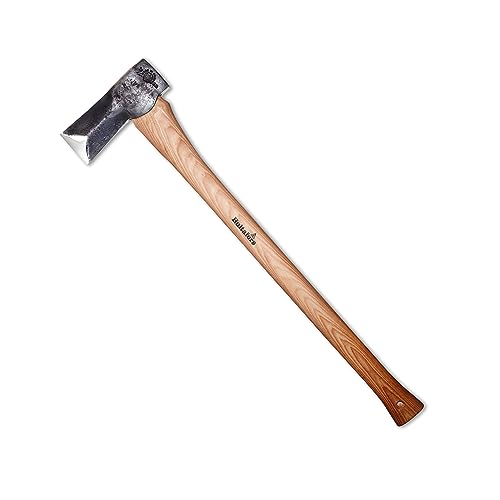
5. Hultafors Agdor splitting axe – best traditional option
Around £70-90. Swedish forged steel on a hickory handle. It splits about as well as the Fiskars and costs similar money, so the case for it is partly aesthetic and partly practical: a wooden handle can be replaced when it breaks, and it damps shock better than any composite.
Pros: rehandleable, so it can last a lifetime; excellent steel that takes and holds a proper edge; pleasant to use.
Cons: hickory needs looking after – store it dry and oil it occasionally, or the head will loosen; an overstrike will damage the handle where a composite would shrug it off.
Best for: anyone who wants a tool they can maintain rather than replace.
6. Gransfors Bruk splitting maul – best for life
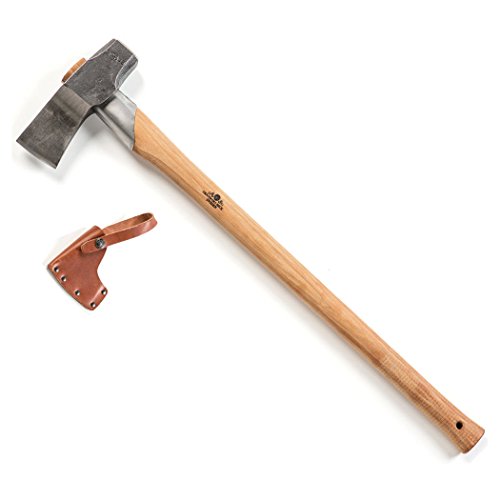
Around £190-230. Hand-forged in Sweden, with the smith’s initials stamped on the head and a 20-year guarantee. At roughly 3.2kg it is a proper maul, and it will part rounds that stop everything else in this list. It is also, plainly, a lot of money for a tool that does the same job as a £70 Fiskars for 90 per cent of use cases.
Pros: exceptional steel and finish; genuinely a lifetime tool; the hammer poll drives wedges through anything.
Cons: the price is hard to justify unless you split a great deal; heavy enough to be tiring; needs proper care.
Best for: smallholders, and people who buy tools once.
At a glance
Model | Head weight | Handle | Best for | Around |
Draper 94987 fibreglass | 1.8kg | Fibreglass | Occasional use | £25-35 |
Fiskars X7 hatchet | 0.6kg | Composite | Kindling | £35-45 |
Fiskars X25 | 2.4kg | Composite 72cm | Most gardens | £60-75 |
Fiskars X27 | 2.6kg | Composite 91cm | Large rounds | £70-90 |
Hultafors Agdor | 2.0kg | Hickory | Traditionalists | £70-90 |
Gransfors Bruk maul | 3.2kg | Hickory | Heavy work | £190-230 |
Technique matters more than the axe
- Split on a low, solid block – a wide round of hardwood is ideal. Splitting on the ground wastes most of the energy and blunts the edge on stones.
- Stand with the log at the far edge of the block, not the near edge. If you miss, the head goes into the block rather than into your shin.
- Aim for a point on the far side of the log, not the top of it. You want the head still accelerating as it enters.
- Let the weight do the work. A relaxed, fast swing splits better than a tense, forced one, and hurts far less the next day.
- Go for the edge on big rounds. Take slabs off the outside rather than trying to halve it through the centre.
- Look for existing cracks and aim at them. Seasoned wood tells you where it wants to split.
Keeping the edge
A splitting axe does not need to be razor sharp – it is a wedge, not a knife – but it does need to be clean and even. A blunt, chipped edge bounces. A few passes with a coarse then fine file, or a puck-style sharpening stone, two or three times a season is enough. Keep the original bevel angle rather than trying to thin it; a thin edge on a splitting axe chips and sticks.
Store it indoors and dry. Steel rusts, hickory shrinks, and a loose head is genuinely dangerous. If a wooden handle does loosen, soak the head end in water only as a short-term measure – the real fix is a new wedge or a new handle.
Frequently asked questions
How heavy should my axe be?
For most people, 2 to 2.5kg on a 70-90cm handle. Heavier is not better unless you are splitting large hardwood rounds regularly – you will tire long before the wood gives in.
Do I still need an axe if I have a log splitter?
Yes. A hydraulic splitter is slow for kindling and pointless for a couple of logs, and you cannot carry it to the woodpile. Most wood burners end up using both.
Composite or wooden handle?
Composite for durability and for anyone who overstrikes. Wood if you want to rehandle it and prefer the feel. Neither splits better than the other.
Are cheap axes safe?
Generally yes, from established brands sold by UK retailers. Avoid unbranded axes with painted heads – the paint hides poor forging, and a head that separates from the handle mid-swing is the one genuinely dangerous failure mode.
Our verdict
The Fiskars X25 is the axe we would buy for an average UK garden: enough head weight and handle length to split ordinary firewood cleanly, light enough to keep using, and priced sensibly. Taller users splitting bigger rounds should go straight to the X27. If you like tools you can maintain, the Hultafors Agdor is the better long-term buy, and the Gransfors maul is genuinely superb if you split enough wood to justify it.
Whatever you choose, pair it with a hatchet for kindling and a decent chopping block. Those two things improve the job more than any upgrade to the axe itself.