
A blunt chainsaw is not just slow, it is dangerous. A sharp chain pulls itself into the wood and throws coarse chips. A blunt one produces fine dust, needs pushing, overheats the bar, and is far more likely to kick back because you are leaning on it. Most of the chainsaw accidents that are not caused by poor technique are caused by a chain that should have been sharpened an hour earlier.
The good news is that sharpening is a fifteen-minute skill, and the tools cost a fraction of a new chain. With autumn cutting season starting, here is what actually works.
Quick verdict
- Best overall: Stihl 2-in-1 EasyFile filing guide (around £40-50)
- Best budget option: Oregon universal field sharpening kit (around £20-30)
- Best for the workshop: Oregon 410-230 bench grinder (around £250-330)
- Best mid-range powered option: Portek Chainmaster bench sharpener (around £120-160)
- Best for absolute beginners: Oregon bar-mounted filing jig (around £60-130)
- Best 12V option for the field: Stihl or Oregon 12V sharpener (around £70-110)
Three ways to sharpen a chain
Hand files and guides
A round file matched to your chain pitch, held at the correct angle, taken through each cutter with a few strokes. Cheap, portable, and it removes the least metal, so your chain lasts longest. It needs a little practice and a guide of some sort, because holding a consistent angle freehand is much harder than it looks.
Bar-mounted jigs
A frame that clamps onto the guide bar and holds the file at a fixed angle and depth. It takes the judgement out entirely – you set it once and every cutter comes out identical. Slower per tooth than a practised hand, but the results are consistent from the first attempt.
Electric bench grinders
A small grinding wheel on an adjustable head. You remove the chain, clamp it in the vice and index each cutter. Fast, accurate and the only sensible option if you are sharpening several chains regularly. The downside is real: a grinding wheel removes far more metal than a file, and it generates heat that can draw the temper out of the cutter if you are heavy-handed. A chain that would take twenty hand sharpenings might take eight on a grinder.
What the numbers on your chain mean
Before buying anything, find your chain’s pitch – usually 3/8in low profile, 0.325in or 0.404in – because it determines the file diameter. Common pairings are a 4.0mm file for 3/8in low profile, 4.8mm for 0.325in and 5.5mm for 0.404in, though you should check your chain’s own specification rather than assume. It is stamped on the drive links or printed on the chain packaging.
Get this wrong and you will either not reach the cutting edge at all, or you will file the gullet away and ruin the chain. It is the one thing worth double-checking before you order.
The best chainsaw sharpeners in the UK
1. Oregon universal field sharpening kit – best budget buy
Around £20-30. Two or three round files, a flat file, a depth gauge tool, a filing guide plate and a handle, in a roll. Everything needed to sharpen a chain properly, for less than the price of a replacement chain.
Pros: covers the depth gauges as well as the cutters, which cheaper kits skip; files are decent quality and replaceable; packs into a jacket pocket.
Cons: the flat guide plate is basic and takes practice to use consistently; files wear out and need replacing; no angle assistance beyond the printed lines.
Best for: occasional users willing to learn the technique.
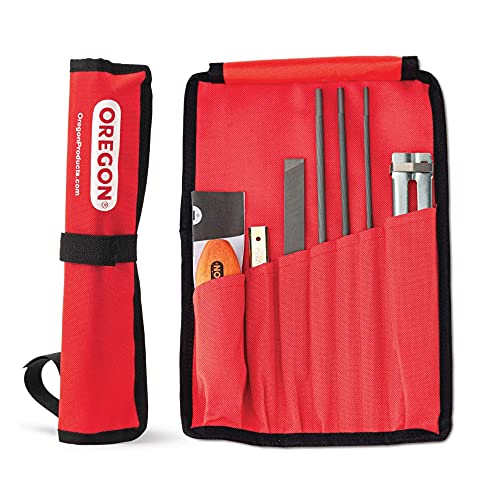
- Universal, portable chainsaw sharpening kit, designed to sharpen your saw while you’re on the job
- Comprehensive kit includes 1 x 5/32 Inch (4.0 mm) round saw chain file, 1 x 3/16 Inch (4.8 mm) round saw chain file, 1 x 7/32 Inch (5.5 mm) round saw chain file, 1 x 6 Inch flat file, 1 x file guide, 1 x universal file handle and instruction sheet
- Convenient and portable kit comes with rolled pouch with inner pockets and hook and loop closure
- Instruction sheet inserted into the handle pocket for safe-keeping and easy access
- Limited lifetime warranty

2. Stihl 2-in-1 EasyFile – best overall
Around £40-50 from Screwfix and Stihl dealers. Two round files and a flat file held in one moulded body, so a single stroke sharpens the cutter and dresses the depth gauge at the same time. That combination is the reason we recommend it: depth gauges are the thing nearly everyone neglects, and a chain with correct cutters but untouched rakers will still refuse to bite.
Pros: fastest hand method by a wide margin; near-impossible to get the angle wrong; consistent results from the first chain; works on the saw, in the field.
Cons: you must buy the version matching your chain pitch, and it will not work on others; replacement files are not cheap; the plastic body is not indestructible.
Best for: almost everyone with one or two saws. This is the tool we would buy first.
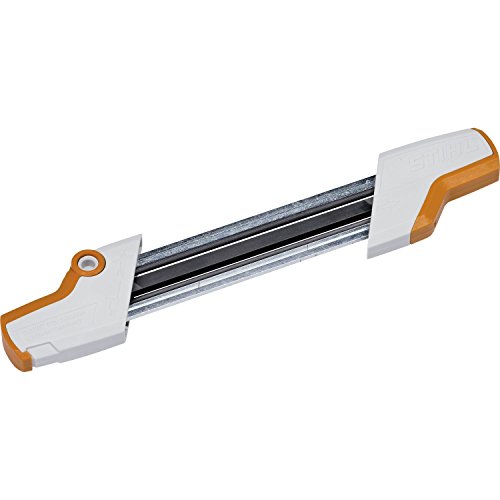
- Package dimensions:2.9 cms(L) x8.2 cms(W) x39.9 cms(H)
- Package quantity: 1
- Product Type: TOOLS
- Country Of origin: United States
3. Oregon bar-mounted filing guide – best for beginners
Around £45-65. A cast frame that clamps to the bar with adjustable angle, depth and stop settings. Set it up once and it will reproduce the same cutter geometry indefinitely, which is exactly what a beginner needs and what a rushed hand sharpening rarely achieves.
Pros: genuinely idiot-proof once set; excellent for restoring a chain that has been badly filed; works with any pitch by changing the file.
Cons: slow – allow half an hour for a full chain; the setup process is fiddly the first time; the clamp can mark a soft bar.
Best for: anyone whose freehand sharpening has left the chain cutting in a curve.
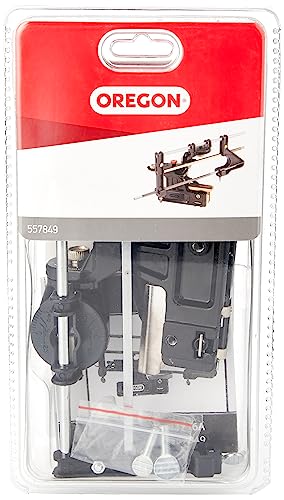
- Professional precision filing guide
- Superior accuracy
- Easy to install meaning you spend less time sharpening and more time on the job
- Universal: can use all sizes of round chainsaw files (Not included)
- Suitable for all chainsaw chains and brands
4. Hand-crank tungsten sharpening jig – the budget carbide option
Around £20-30. A bar-mounted jig using tungsten-tipped cutters turned by hand rather than a file. Unbranded and inexpensive – it is the same basic idea as the premium carbide jigs (crank the cutter through the gullet instead of filing it) at a fraction of the price, though the finish and durability are not in the same league as name-brand versions.
Pros: no power needed; tungsten bits outlast a set of files; compact and cheap enough to keep as a spare in the truck.
Cons: nowhere near as refined as premium carbide jigs; tungsten bits are not as durable as proper branded carbide; build quality is basic and the crank can feel flimsy.
Best for: budget-conscious users who want to try a carbide-style jig without paying premium-brand prices.
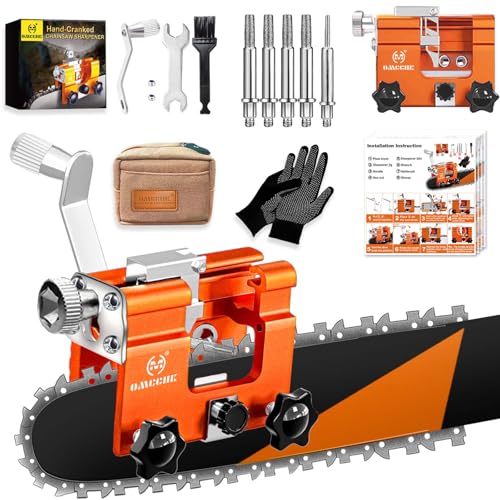
- Wide Compatibility: This adjustable chainsaw sharpener fits most standard chainsaws ranging from 4 to 22 inches, working perfectly with gas and electric chainsaws for versatile use at home, farm, and garden.
- Extra 5 Upgraded Tungsten Steel Sharpening Bits: Our chainsaw sharpener comes with 5 high-hardness tungsten steel bits, more than the common 3–5 standard bits from other brands. These premium tungsten steel bits are ultra-durable and long-lasting, greatly reducing frequent replacements and saving you time and money.
- Portable Storage Çarrying Bag Included: Comes with a dedicated storage carry bag for neat organization and easy portability. Effectively prevents loss of accessories, saves storage space, and allows you to carry and use the sharpener conveniently anywhere you need.
- Professional & User-Friendly Design: As a professional chainsaw sharpener provider with over 5 million units sold worldwide, we have helped countless users restore dull chains effectively. This sharpener comes with detailed instruction manuals in 6 languages (English, Spanish, German, French, Italian, and more), making operation simple, clear, and easy to master for global users.
- Precision Sharpening & Complete Accessories: The industrial-grade sharpening stone delivers clean, burr-free sharp edges every time, while the secure locking mechanism ensures accurate and safe angle control. We also include a pair of protective gloves and a cleaning brush for safer operation, easier maintenance, and a better overall user experience.
5. Portek Chainmaster bench sharpener – best mid-range powered option
Around £120-160. A 240V bench-mounted grinder with an 85 watt motor, sold widely in the UK and sized for domestic and light professional use. It handles any chain size and brand, and it turns a fifteen-minute job into a four-minute one.
Pros: far faster than filing; good value for a powered machine; adjustable angles cover all common chain geometries; UK support and spares.
Cons: the motor is modest, so do not expect professional duty cycles; setup takes patience; easy to remove too much metal until you learn a light touch.
Best for: anyone running two or more saws, or maintaining several spare chains.

- 4.5mm 3.2mm thickness (3.2mm supplied) - Motor: 240v, 85W, 4,200 rpm - Robust and durable for long life
- This professional chainsaw sharpener keeps chainsaw chains of all makes and sizes at peak performance
- Suitable for all makes and sizes of chains
- Fully adjustable 0 - 35° cutting angle
- Replaceable grinding wheels
6. Oregon 410-230 bench grinder – best for the workshop
Around £250-330. The machine most professionals end up with. Solidly built, precise adjustment, and a grinding head that stays where you set it – which is the single biggest difference between this and cheaper grinders, where the head drifts and each cutter comes out slightly different.
Pros: professional accuracy and durability; fast; handles everything from 1/4in to 0.404in; wheels widely available.
Cons: expensive for domestic use; needs permanent bench space; still removes more metal than filing, so chains have a shorter overall life.
Best for: smallholders, tree surgeons and anyone sharpening chains for other people.
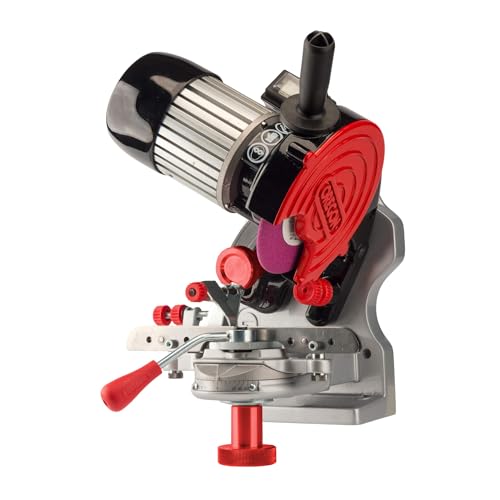
- Bench or wall mounted Professional grinder: Perfect for semi-professional and home users who regularly saw wood
- Save time and money: Sharpen your own chainsaw chains. Grinder easily mounts to a bench or wall with two included bolts - ideal for a workshop or garage
- Universal chainsaw sharpener: Electric chainsaw chain sharpener, sharpens up to .404 Inch pitch chain. Sharpen almost any saw chain from manufacturers such as Oregon, Stihl, Husqvarna, and others
- One-way motor rotation: Accurate chain saw sharpening device provides greater operator safety and comes with a manual chain clamping vice
- Includes: Grinder, a dressing brick and profile guide, operator instructions plus two grinding wheels (3.2mm and 4.7mm) and a 6.0mm flat profile disc for depth gauge maintenance
At a glance
| Sharpener | Type | Speed | Skill needed | Around |
| Oregon field kit | Files and guide | Slow | Some | £20-30 |
| Stihl 2-in-1 EasyFile | Combined file guide | Fast | Very little | £40-50 |
| Oregon filing guide | Bar-mounted jig | Slow | None | £60-80 |
| Tungsten hand-crank jig | Bar-mounted carbide jig | Moderate | None | £20-30 |
| Portek Chainmaster | Electric bench | Very fast | Some | £120-160 |
| Oregon 410-230 | Electric bench | Very fast | Some | £250-330 |
How to sharpen a chain by hand
- Chock the chain or engage the brake so it cannot move, and wear gloves. Cutters are sharper than they look even when blunt.
- Mark your starting cutter with a marker pen so you know where you began.
- Set the file in the gullet at the angle marked on your guide – usually 25 or 30 degrees – and hold it level or slightly raised as specified for your chain.
- Push the file forward only, three to five strokes per cutter. Lift it on the return; dragging it back dulls the file.
- Do every cutter on one side, then turn the saw round and do the other. Use the same number of strokes on each so the cutters stay equal length.
- Check the depth gauges every third or fourth sharpening with the flat file and gauge tool. If the rakers are too high the chain will not bite no matter how sharp the cutters are.
- Wipe the chain and give it a squirt of bar oil before you put the saw away.
When to sharpen, and when to replace
Sharpen when the saw stops pulling itself into the cut, when the chips turn to dust, or the moment you touch soil, grit or a nail. Do not wait for the end of the job – a chain that has hit dirt is blunt in seconds and cutting with it damages the bar as well.
Replace the chain when the cutters have been filed back to the wear mark stamped on the top plate, when cutters are cracked or missing, or when the chain will not hold tension because the rivets have worn. A well-maintained chain sharpened by hand can last years; the same chain on a heavy-handed grinder might manage one season.
Frequently asked questions
How often should I sharpen?
Roughly every tank of fuel in clean wood, and immediately after any contact with soil or metal. Little and often removes far less material than waiting until it is truly blunt.
Can I use a rotary multi-tool with a chainsaw sharpening kit?
You can, and the cheap kits sold for this work, but they spin fast and remove metal quickly. It is very easy to overheat a cutter and blue the steel, which softens it permanently.
Do I need to sharpen the depth gauges?
Yes, though not every time. Every third or fourth sharpening is a reasonable rule. Skipping them entirely is the most common reason a freshly sharpened chain still cuts poorly.
Is it cheaper to just buy new chains?
Not once you have sharpened three or four times. A chain costs £20-35, a hand sharpener £40, and a chain will take many sharpenings. Sharpening also cuts better than a worn new chain that has been dulled once.
Our verdict
For the vast majority of UK users the Stihl 2-in-1 EasyFile is the one to buy. It is quick, it is nearly impossible to use wrongly, it deals with the depth gauges that most people ignore, and it costs about the same as one replacement chain. Buy the version that matches your chain pitch and it will keep your saw cutting properly for years.
If freehand filing has never worked for you, the Oregon filing guide removes the judgement entirely. And if you keep several chains or several saws, a bench grinder pays for itself in time saved – the Portek for domestic use, the Oregon 410-230 if you want the machine that professionals rely on.